Today, Friday, May 27th 2011 at 7:30pm (GMT -08:00), the American Cinematheque will show Psycho at The Egyptian Theatre in Los Angeles... and I won´t be there. :(
View Larger Map
27 May 2011
16 May 2011
11 May 2011
16mm FILM FOR SALE
UP FOR SALE is this film:
SPECS
NAME: Eurokai
YEAR: Unknown
FORMAT: 16mm
LENGTH: 400ft/120mts.
RUNNING TIME: 17 min.
YEAR: Unknown
FORMAT: 16mm
LENGTH: 400ft/120mts.
RUNNING TIME: 17 min.
BASE: Estar
SOUND: Mono (Mag)
LANGUAGE SPOKEN: N/A
SUBTITLES: N/A
CONDITION OF FILM: Very good. Little or no scratching. Slight color fade.
SOUND: Mono (Mag)
LANGUAGE SPOKEN: N/A
SUBTITLES: N/A
CONDITION OF FILM: Very good. Little or no scratching. Slight color fade.
Price: USD 20,00+shipping and hadling
*I would be willing to trade it for another title.
Dragonfly_films is a member of eBay (USA), Todocolección.com (Spain), Mercadolibre.com (Latin America). For transparency´s sake I will publish this film in the buyer´s choice of auction site. Interested parties, email me or leave a comment on this post.
16mm FILM FOR SALE
UP FOR SALE is this film:
SPECS
NAME: F850 Eurokai / Siemens
YEAR: Unknown
FORMAT: Super8
LENGTH: 400ft/120mts.
RUNNING TIME: 17 min.
YEAR: Unknown
FORMAT: Super8
LENGTH: 400ft/120mts.
RUNNING TIME: 17 min.
BASE: Estar
SOUND: Mono (Mag)
LANGUAGE SPOKEN: N/A
SUBTITLES: N/A
CONDITION OF FILM: Very good. Little or no scratching. Slight color fade.
SOUND: Mono (Mag)
LANGUAGE SPOKEN: N/A
SUBTITLES: N/A
CONDITION OF FILM: Very good. Little or no scratching. Slight color fade.
Price: USD 20,00+shipping and hadling
*I would be willing to trade it for another title.
Dragonfly_films is a member of eBay (USA), Todocolección.com (Spain), Mercadolibre.com (Latin America). For transparency´s sake I will publish this film in the buyer´s choice of auction site. Interested parties, email me or leave a comment on this post.
10 May 2011
CHASING PSYCHO (chapter 1)
As some of you know, as part of the 50th Anniversary Celebration of the Release of Alfred Hitchcock´s Psycho, the negatives were restored and new prints were issued in 35mm. Also a Blu-Ray edition was marketed on October 19, 2010, but for "home-enjoyment".
Fresh out of youtube, a clip of how the original mono mix from the film was separated to create a new 5.1 mix for the rerelease. (Let us not get into the ethics of film preservation here, shall we?)
It has been a dream of mine to watch Psycho in the big screen ever since I was 15 years old, and I got a peek of it in Universal´s: "Alfred Hitchcock: The Art of Making Movies". Ever since then, the film has been eluding me. Twenty years and counting.
Four years ago, my dream had to be reformulated with the appearence of this dreadful digital technology. Now I not only had to catch it in the big screen, but I also had to watch it projected in 35mm.
This will be a series of posts about how the film pops-up here and there and I won´t be around to watch it.
30 Apr 2011
28 Apr 2011
Cinematreasures.org
Discover. Preserve. Protect.
Full disclosure: they are a bit anal when it comes to form. The Editing Policy is a bit on the demanding site, although harmless. Highly recommended site.
| This is my own adition. The Cine Gaumont. |
26 Apr 2011
25 Apr 2011
Memory & Imagination: New Pathways to the Library of Congress
Excerpt from the film produced by Michael Lawrence Films and Krainin Productions.
24 Apr 2011
RESTORATION (DATE April 23rd, 2011)
It is finally here. It took almost 2 months to fly from NZ to Argie, but it was worth the wait.
| The FPS gauge |
| Its new home |
Together at last |
Etiquetas:
Ernemann Projectors and Equipment,
My Ernemanns
21 Apr 2011
RESTORATION DATE (March 29th, 2011)
Trying to piece together this Reyes Soundhead from odd bits and pieces is not an easy process. As you can see, not all pieces come from the same sources, and hence, not all fit the way they should.Funny detail about the assembly: the soundhead door has a nook tailor cut for the pipe that carries the solar cell wires, in the upper right corner of the glass window.
Conclusions: the pipe is in the right place, but of the incorrect length. There has to be more than one size of it, despite what the experts say.
20 Apr 2011
DISCONTINUED PROCESSES: VistaVision
VistaVision is a higher resolution, widescreen variant of the 35mm motion picture film format which was created by engineers at Paramount Pictures in 1954.
VistaVision was Paramount´s response to 20th Century Fox´s Cinemascope, which in turn was devised with the intention of stealing some of the crowds that were drawn to the few Cinerama theatres available in the world. It seemed that widescreen features were the answer to Hollywood´s prayers to try and lure audiences back into the theatres and away from the new technological threat: the TV set.
The soul of the VistaVision process was 35mm film, but travelling horizontally in the gate (instead of vertically) at eight sprocket holes per frame (instead of 4), giving a negative image area nearly three times bigger than the standard negative aperture.
The process included new wider angle lenses to give greater scope on the big screens and PERSPECT-A STEREOPHONIC SOUND. This type of sound was comprised of a single photographic sound track located in the standard position so that they will reproduce on any standard optical sound head in any projector the world over. What made it PERSPECT-A, was the use of frequencies below 30Hz as modulated control signals that assigned a certain sound source -one of the speakers located throughout the audiorium- to different parts of the soundtrack.
One of the design breathroughs of the PERSPECT-A system was that the sound control units had an automatic return to monaural sound in case of trouble. Today that is mainstream with all digital 35mm sound formats.
"All release prints will have a single photographic sound track that will play on every standard sound reproducer the world over. Paramount does not contemplate the release of any pictures with either a separate or four-track magnetic film. Further, Paramount does not contemplate releasing any prints having the Fox-Eastman narrow sprocket holes."
"PESPECT-A SOUND will expand music to multiple loudspeakers and control the direction of the sound source when and as it is required for dramatic effectiveness. Paramount suggests this type of sound for those exhibitors who desire multi-horn reproduction and who wish to fill the theater with sound. The present experience indicates that stereophonic sound is of questionable value in the smaller theaters. It may add to the effectiveness in large theaters with very large screens. The decision as to its use rests with the exhibitor. In selecting Perspect-a-Sound for VistaVision pictures, Paramount is moving toward standardization. It is our hope that we can gain complete compatibility with M.G.M., Warners and others."The VistaVision process did not introduce any modifications to the everyday 35mm exhibition print. It was merely a capture process to preserve the optical sharpness and contrast of the original negatives to produce better quality prints. It was processed by Technicolor and optically reduced directly from the negative to the Technicolor matrix which in turn was used to stamp out the release print by the imbibition process.
This gave a wider aspect ratio of 1.5:1 versus the conventional 1.37:1 Academy ratio, and a much larger image area. In order to satisfy all theaters with all screen sizes, VistaVision films were shot in such a way that they could be shown in one of three recommended aspect ratios: 1.66:1, 1.85:1 and 2.00:1.
Loren L. Ryder, chief engineer at Paramount, expressed four general reasons why he thought Paramount's VistaVision would be the forerunner of widescreen projection in most theaters:
- VistaVision could be shown at widescreen aspect ratios between 1.66 to 2.00:1.
- VistaVision could be (and most often was) further printed down to standard vertical 35mm reels keeping its 1.66:1 widescreen aspect ratio, which meant exhibitors did not need to purchase additional projection equipment, unlike CinemaScope.
- VistaVision did not cut down the number of seats in any theater (such as Cinerama and CinemaScope).
- VistaVision allowed patrons to see more and therefore gain more enjoyment out of a feature.
"White Christmas", "Strategic Air Command", "To Catch a Thief" and "The Battle of the River Plate" had very limited (two or three) prints struck in the 8-perf VistaVision format in which they were shot. Although the clarity of these 8-perf prints was striking, they were used only for premiere or preview engagements between 1954 and 1956 and required special projection equipment. This exhibition process was impractical because for the footage to travel through a projector at the normal 24 frames per second, the film had to roll at 3 feet per second, double the speed of 35 mm film and causing many technical and mechanical problems. Aside from these prints all other VistaVision films were shown in the conventional 4-perf format, as planned.
Alfred Hitchcock used VistaVision for many of his films in the 1950s. However, by the late 1950s with the introduction of finer-grained color stocks and the disadvantage of shooting twice as much negative stock, VistaVision became obsolete. Paramount dropped the format after only seven years, although for another forty years the format was used for high resolution special effects sequences. Less expensive anamorphic systems such as Panavision and the more expensive 70 mm format became standard during the later 1950s and 1960s.
List of all Films Shot in VistaVision
Sources:
Wikipedia
Widescreenmuseum.com
Etiquetas:
35mm Film,
Discontinued processes,
Hitchcock
19 Apr 2011
THE EVOLUTION OF DOLBY FILM SOUND
Going to the movies today is more exciting and involving than ever before, thanks in large part to a continuing effort to improve film sound undertaken by Dolby Laboratories in the early 1970s. Indeed, the history of cinema sound over the past two decades closely mirrors the history of Dolby film sound technologies.
Optical soundtracks
The photographic, or “optical,” soundtrack was the first method of putting sound on film. Today it remains the standard, in both analog and digital forms. The classic analog optical soundtrack consists of an opaque area adjacent to the picture containing narrow, clear tracks that vary in width according to variations in the sound. As the film is played, a beam of light from an exciter lamp or LED in the projector’s soundhead shines through the moving tracks. Variations in the width of the clear tracks cause a varying amount of light to fall on a solar cell, which converts the light to a similarly varying electrical signal. That signal is amplified and ultimately converted to sound by loudspeakers in the auditorium.
Economy, simplicity, and durability are among the advantages that have contributed to optical sound’s universal acceptance. The soundtrack is printed photographically on the film at the same time as the picture and can last just as long, which— with care—can be a long time indeed. And the optical soundhead within the projector is itself economical and easily maintained.
Success gets in the way of progress
Motion pictures with sound were first shown to significant numbers of moviegoers in the late 1920s. Within a few years, many thousands of theatres were equipped to show “talking pictures” with optical soundtracks.
This phenomenally rapid acceptance of a new, sophisticated technology was not without drawbacks, however. Equipment was installed in cinemas so rapidly that there was no time to take advantage of the improvements that occurred almost daily. A good example is loudspeaker design. The first cinema loudspeakers had very poor high-frequency response. Speakers with superior response became available within just a few years, but there was no time to retrofit the original systems with new units.
Engineers were too busy equipping other cinemas with their first sound installations. This caused a dilemma for soundtrack recordists. Should the tracks be recorded to take advantage of the improved speakers, or should they be prepared to sound best on the many older installations already in place? Given that it was impractical to release two versions of a given title, the only alternative was to tailor soundtracks to the older speakers. The result was to ignore the improved high frequency response of the newer, better units.
To forestall compatibility problems, in the late 1930s a de facto standardization set in, the cinema playback response that today is called the “Academy” characteristic. Cinema owners knew what to expect from
the films, and therefore what equipment to install. Directors and sound recordists knew what to expect from cinema sound systems, and thus what kind of soundtracks to prepare. The result was a system of sound recording and playback that made it possible for just about any film to sound acceptable in any cinema in the world. The problem was that the system lacked the flexibility to incorporate improvements beyond the limitations that existed in the 1930s.
Magnetic striping and multichannel sound
In the early 1950s, as the film industry sought to woo viewers away from their fascinating new television sets, a new method of putting sound on film was introduced. After the picture was printed, narrow stripes of
iron oxide material (similar to the coating on magnetic recording tape) were applied to the release print. The sound was then recorded on the magnetic stripes in real time. In the cinema, magnetic prints would be played back on projectors equipped with magnetic heads similar to those on a tape recorder, mounted in a special soundhead assembly called a “penthouse.”
Magnetic sound was a significant step forward, and at its best provided much-improved fidelity over the conventional optical soundtrack. It also enabled the first multichannel sound reproduction, dubbed “stereophonic sound,” ever heard by the public. The voice of an actor appearing to the left, center, or right of the picture could be heard coming from speakers located at the left, center, or right of the new wide screens also being introduced at this time. Music took on a new dimension of realism, and special sound effects could emanate from the rear or sides of the cinema. The two main magnetic systems adopted were the four-track 35 mm CinemaScope system, introduced with The Robe, and the six-track 70 mm Todd-AO, first used for Oklahoma!
Magnetic falls into disuse
Magnetic sound was widely adopted in the 1950s. By the 1970s, however, when the film industry experienced an overall decline, the expense of magnetic release prints, their comparatively short life compared to optical prints, and the high cost of maintaining the playback equipment led to a massive reduction in the number of magnetic releases and cinemas capable of playing them. Magnetic sound came to be reserved for only a handful of first-run engagements of “big” releases each year. By the mid-1970s, then, movie-goers were again hearing low-fidelity, mono optical releases most of the time, with only an occasional multitrack stereo magnetic release. Ironically, just as the industry was reverting to mono optical, more and more moviegoers were enjoying better sound at home over superior hi-fi stereo systems.
Dolby gets involved
By the late 1980s, the situation that prevailed in the mid-1970s had completely changed. Thanks to new technology and a turnaround in the financial decline of the industry, almost all major titles by that time were being released with wide-range multichannel stereo soundtracks, as is the case today. The breakthrough was the development by Dolby Laboratories of a highly practical 35 mm stereo optical release print format originally identified as Dolby Stereo. In the space allotted to the conventional mono optical soundtrack are two soundtracks that not only carry left and right information as in home stereo sound, but are also encoded with a third center screen channel and—most notably—a fourth surround channel for ambient sound and special effects.
This format not only enabled stereo sound from optical soundtracks, but higher-quality sound as well. Various techniques were applied to the soundtrack during both recording and playback to improve fidelity.
Foremost among these was Dolby A-type noise reduction to lower the hissing and popping associated with optical soundtracks, and loudspeaker equalization to adjust the cinema sound system to a standard
response curve.
As a result, stereo optical prints could be reproduced in cinemas installing Dolby cinema processors with far wider frequency response and much lower distortion than conventional soundtracks. In fact, the Dolby optical format led to a new worldwide playback standard (ISO 2969) for wide-range stereo prints.
An important advantage of the Dolby optical format was that the soundtracks were printed simultaneously with the picture, just like mono prints. Thus four-channel stereo optical release prints cost no more to make than mono prints, and far less than magnetic prints. In addition, conversion to stereo optical proved relatively simple, and once the equipment was installed, very little maintenance was required. The result was multichannel capability equaling that of four-track magnetic 35 mm (which soon became obsolete), with consistently higher fidelity, greater reliability, and far lower cost.
The next step: Dolby SR
In 1986, Dolby Laboratories introduced a new professional recording process called Dolby SR (spectral recording). Like Dolby noise reduction, it was a mirror-image, encode-decode system used both when a soundtrack is recorded and when it is played back. It provided more than twice the noise reduction of Dolby A-type, and, moreover, permitted loud sounds with wider frequency response and lower distortion.
The 35mm optical soundtracks treated with Dolby SR instead of Dolby A-type not only sounded superb in cinemas equipped with new SR processors, but also played back satisfactorily in all cinemas. This led to the situation today, whereby the analog soundtracks on virtually all prints are Dolby SR tracks.
The digital age begins
The next film sound development from Dolby Laboratories was Dolby Digital, introduced in 1992. Dolby Digital puts a six-channel digital optical soundtrack in addition to a four-channel SR analog track on 35 mm prints. This format is yet another significant step forward in film sound, providing independent left, center, right, left surround, and right surround channels, plus a sixth channel for bass effects. In addition to its six-channel capability, Dolby Digital provides extraordinary dynamic capability, wide frequency range, low distortion, and relative immunity to wear. Its combination of high quality, reliability, and practicality has been proved in cinemas around the world, and today it is the most popular digital format, with the most releases, and the most cinemas worldwide equipped to play them. As with previous Dolby developments, Dolby Digital did not make existing cinema installations obsolete. Prints can play conventionally in any cinema, while the digital track can be reproduced in cinemas with Dolby Digital soundtrack readers and decoders.
Dolby Digital Surround EX
The newest Dolby format, Dolby Digital Surround EX, was introduced in 1999, and adds a third surround channel to the Dolby Digital format. Enabling improved realism, more precise sound placement, and exciting
special effects, the third channel is reproduced by rear-wall surround speakers, while the left and right surround channels are reproduced by speakers on the side walls. As with all other Dolby soundtrack improvements, Dolby Digital Surround EX is backwards-compatible, with prints playable in all Dolby Digital cinemas, whether or not equipped to decode the additional surround track. To find films that use the new format and cinemas in your area equipped to play it, visit www.dolby.com/movies.
Making films sound better
Film soundtracks encoded with Dolby technologies, and the equipment for playing them, are only links in a chain that extends from the original location, through the dubbing theatre, to the processing laboratory, and
finally into the cinema. Developments like Dolby SR and Dolby Digital ensure that the soundtrack itself remains one of the strongest links. But the extreme fidelity of the latest Dolby formats can reveal the quality of each step in the recording, mixing, and dubbing processes, and this has necessitated new approaches to soundtrack production. Admittedly, the results can vary—the final reproduced soundtrack can be no better than the elements it comprises—but Dolby film sound at its best means not only better sound quality, but sound in the theatre that consistently realizes the director’s original intentions.
While Dolby Laboratories’ involvement with film sound first achieved wide recognition with the spectacular audio effects of such films as Star Wars, it has long since come to mean more than just special or dramatic effects. The objective is high-quality sound reproduction overall— from the dialogue and the score to the sound design and effects. Dolby technology is a means, not an end. It can be likened to an artist’s palette that provides the director with a full range of colors, where before there were but a few. Above all, Dolby formats have been developed to enhance that very special experience of going to the movies.
Optical soundtracks
The photographic, or “optical,” soundtrack was the first method of putting sound on film. Today it remains the standard, in both analog and digital forms. The classic analog optical soundtrack consists of an opaque area adjacent to the picture containing narrow, clear tracks that vary in width according to variations in the sound. As the film is played, a beam of light from an exciter lamp or LED in the projector’s soundhead shines through the moving tracks. Variations in the width of the clear tracks cause a varying amount of light to fall on a solar cell, which converts the light to a similarly varying electrical signal. That signal is amplified and ultimately converted to sound by loudspeakers in the auditorium.
Economy, simplicity, and durability are among the advantages that have contributed to optical sound’s universal acceptance. The soundtrack is printed photographically on the film at the same time as the picture and can last just as long, which— with care—can be a long time indeed. And the optical soundhead within the projector is itself economical and easily maintained.
Success gets in the way of progress
Motion pictures with sound were first shown to significant numbers of moviegoers in the late 1920s. Within a few years, many thousands of theatres were equipped to show “talking pictures” with optical soundtracks.
This phenomenally rapid acceptance of a new, sophisticated technology was not without drawbacks, however. Equipment was installed in cinemas so rapidly that there was no time to take advantage of the improvements that occurred almost daily. A good example is loudspeaker design. The first cinema loudspeakers had very poor high-frequency response. Speakers with superior response became available within just a few years, but there was no time to retrofit the original systems with new units.
Engineers were too busy equipping other cinemas with their first sound installations. This caused a dilemma for soundtrack recordists. Should the tracks be recorded to take advantage of the improved speakers, or should they be prepared to sound best on the many older installations already in place? Given that it was impractical to release two versions of a given title, the only alternative was to tailor soundtracks to the older speakers. The result was to ignore the improved high frequency response of the newer, better units.
To forestall compatibility problems, in the late 1930s a de facto standardization set in, the cinema playback response that today is called the “Academy” characteristic. Cinema owners knew what to expect from
the films, and therefore what equipment to install. Directors and sound recordists knew what to expect from cinema sound systems, and thus what kind of soundtracks to prepare. The result was a system of sound recording and playback that made it possible for just about any film to sound acceptable in any cinema in the world. The problem was that the system lacked the flexibility to incorporate improvements beyond the limitations that existed in the 1930s.
Magnetic striping and multichannel sound
In the early 1950s, as the film industry sought to woo viewers away from their fascinating new television sets, a new method of putting sound on film was introduced. After the picture was printed, narrow stripes of
iron oxide material (similar to the coating on magnetic recording tape) were applied to the release print. The sound was then recorded on the magnetic stripes in real time. In the cinema, magnetic prints would be played back on projectors equipped with magnetic heads similar to those on a tape recorder, mounted in a special soundhead assembly called a “penthouse.”
Magnetic sound was a significant step forward, and at its best provided much-improved fidelity over the conventional optical soundtrack. It also enabled the first multichannel sound reproduction, dubbed “stereophonic sound,” ever heard by the public. The voice of an actor appearing to the left, center, or right of the picture could be heard coming from speakers located at the left, center, or right of the new wide screens also being introduced at this time. Music took on a new dimension of realism, and special sound effects could emanate from the rear or sides of the cinema. The two main magnetic systems adopted were the four-track 35 mm CinemaScope system, introduced with The Robe, and the six-track 70 mm Todd-AO, first used for Oklahoma!
Magnetic falls into disuse
Magnetic sound was widely adopted in the 1950s. By the 1970s, however, when the film industry experienced an overall decline, the expense of magnetic release prints, their comparatively short life compared to optical prints, and the high cost of maintaining the playback equipment led to a massive reduction in the number of magnetic releases and cinemas capable of playing them. Magnetic sound came to be reserved for only a handful of first-run engagements of “big” releases each year. By the mid-1970s, then, movie-goers were again hearing low-fidelity, mono optical releases most of the time, with only an occasional multitrack stereo magnetic release. Ironically, just as the industry was reverting to mono optical, more and more moviegoers were enjoying better sound at home over superior hi-fi stereo systems.
Dolby gets involved
By the late 1980s, the situation that prevailed in the mid-1970s had completely changed. Thanks to new technology and a turnaround in the financial decline of the industry, almost all major titles by that time were being released with wide-range multichannel stereo soundtracks, as is the case today. The breakthrough was the development by Dolby Laboratories of a highly practical 35 mm stereo optical release print format originally identified as Dolby Stereo. In the space allotted to the conventional mono optical soundtrack are two soundtracks that not only carry left and right information as in home stereo sound, but are also encoded with a third center screen channel and—most notably—a fourth surround channel for ambient sound and special effects.
This format not only enabled stereo sound from optical soundtracks, but higher-quality sound as well. Various techniques were applied to the soundtrack during both recording and playback to improve fidelity.
Foremost among these was Dolby A-type noise reduction to lower the hissing and popping associated with optical soundtracks, and loudspeaker equalization to adjust the cinema sound system to a standard
response curve.
As a result, stereo optical prints could be reproduced in cinemas installing Dolby cinema processors with far wider frequency response and much lower distortion than conventional soundtracks. In fact, the Dolby optical format led to a new worldwide playback standard (ISO 2969) for wide-range stereo prints.
An important advantage of the Dolby optical format was that the soundtracks were printed simultaneously with the picture, just like mono prints. Thus four-channel stereo optical release prints cost no more to make than mono prints, and far less than magnetic prints. In addition, conversion to stereo optical proved relatively simple, and once the equipment was installed, very little maintenance was required. The result was multichannel capability equaling that of four-track magnetic 35 mm (which soon became obsolete), with consistently higher fidelity, greater reliability, and far lower cost.
The next step: Dolby SR
In 1986, Dolby Laboratories introduced a new professional recording process called Dolby SR (spectral recording). Like Dolby noise reduction, it was a mirror-image, encode-decode system used both when a soundtrack is recorded and when it is played back. It provided more than twice the noise reduction of Dolby A-type, and, moreover, permitted loud sounds with wider frequency response and lower distortion.
The 35mm optical soundtracks treated with Dolby SR instead of Dolby A-type not only sounded superb in cinemas equipped with new SR processors, but also played back satisfactorily in all cinemas. This led to the situation today, whereby the analog soundtracks on virtually all prints are Dolby SR tracks.
The digital age begins
The next film sound development from Dolby Laboratories was Dolby Digital, introduced in 1992. Dolby Digital puts a six-channel digital optical soundtrack in addition to a four-channel SR analog track on 35 mm prints. This format is yet another significant step forward in film sound, providing independent left, center, right, left surround, and right surround channels, plus a sixth channel for bass effects. In addition to its six-channel capability, Dolby Digital provides extraordinary dynamic capability, wide frequency range, low distortion, and relative immunity to wear. Its combination of high quality, reliability, and practicality has been proved in cinemas around the world, and today it is the most popular digital format, with the most releases, and the most cinemas worldwide equipped to play them. As with previous Dolby developments, Dolby Digital did not make existing cinema installations obsolete. Prints can play conventionally in any cinema, while the digital track can be reproduced in cinemas with Dolby Digital soundtrack readers and decoders.
Dolby Digital Surround EX
The newest Dolby format, Dolby Digital Surround EX, was introduced in 1999, and adds a third surround channel to the Dolby Digital format. Enabling improved realism, more precise sound placement, and exciting
special effects, the third channel is reproduced by rear-wall surround speakers, while the left and right surround channels are reproduced by speakers on the side walls. As with all other Dolby soundtrack improvements, Dolby Digital Surround EX is backwards-compatible, with prints playable in all Dolby Digital cinemas, whether or not equipped to decode the additional surround track. To find films that use the new format and cinemas in your area equipped to play it, visit www.dolby.com/movies.
Making films sound better
Film soundtracks encoded with Dolby technologies, and the equipment for playing them, are only links in a chain that extends from the original location, through the dubbing theatre, to the processing laboratory, and
finally into the cinema. Developments like Dolby SR and Dolby Digital ensure that the soundtrack itself remains one of the strongest links. But the extreme fidelity of the latest Dolby formats can reveal the quality of each step in the recording, mixing, and dubbing processes, and this has necessitated new approaches to soundtrack production. Admittedly, the results can vary—the final reproduced soundtrack can be no better than the elements it comprises—but Dolby film sound at its best means not only better sound quality, but sound in the theatre that consistently realizes the director’s original intentions.
While Dolby Laboratories’ involvement with film sound first achieved wide recognition with the spectacular audio effects of such films as Star Wars, it has long since come to mean more than just special or dramatic effects. The objective is high-quality sound reproduction overall— from the dialogue and the score to the sound design and effects. Dolby technology is a means, not an end. It can be likened to an artist’s palette that provides the director with a full range of colors, where before there were but a few. Above all, Dolby formats have been developed to enhance that very special experience of going to the movies.
18 Apr 2011
"AMERICAN PICKERS" Season 2 Episode 4: Smooth Operators
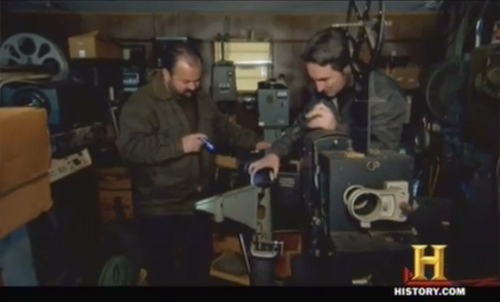
In my recent visit to the States, I came accross this episode of what to me was an unknown series: American Pickers. This particular episode (#4 from season 2) features the two presenters running into a woman (Michelle) who is sitting on a warehouse full of projection equipment.
The equipment used to belong to her father, who passed away on 2010. His name was Bill Goff. Michelle has contacted the guys over at Cinema Treasures where she placed an Ad and left her contact information, in case anyone is interested.
| Source of picture: coolandcollected.com |
16 Apr 2011
12 Apr 2011
FILM IDENTIFIED (IN RECORD TIME): "Первый день мира"
You can find all information for the film, including cast and crew, opening dates and stills in the following links:
In Russian and in English.
HELP IDENTIFYING SOVIET 35mm FILM
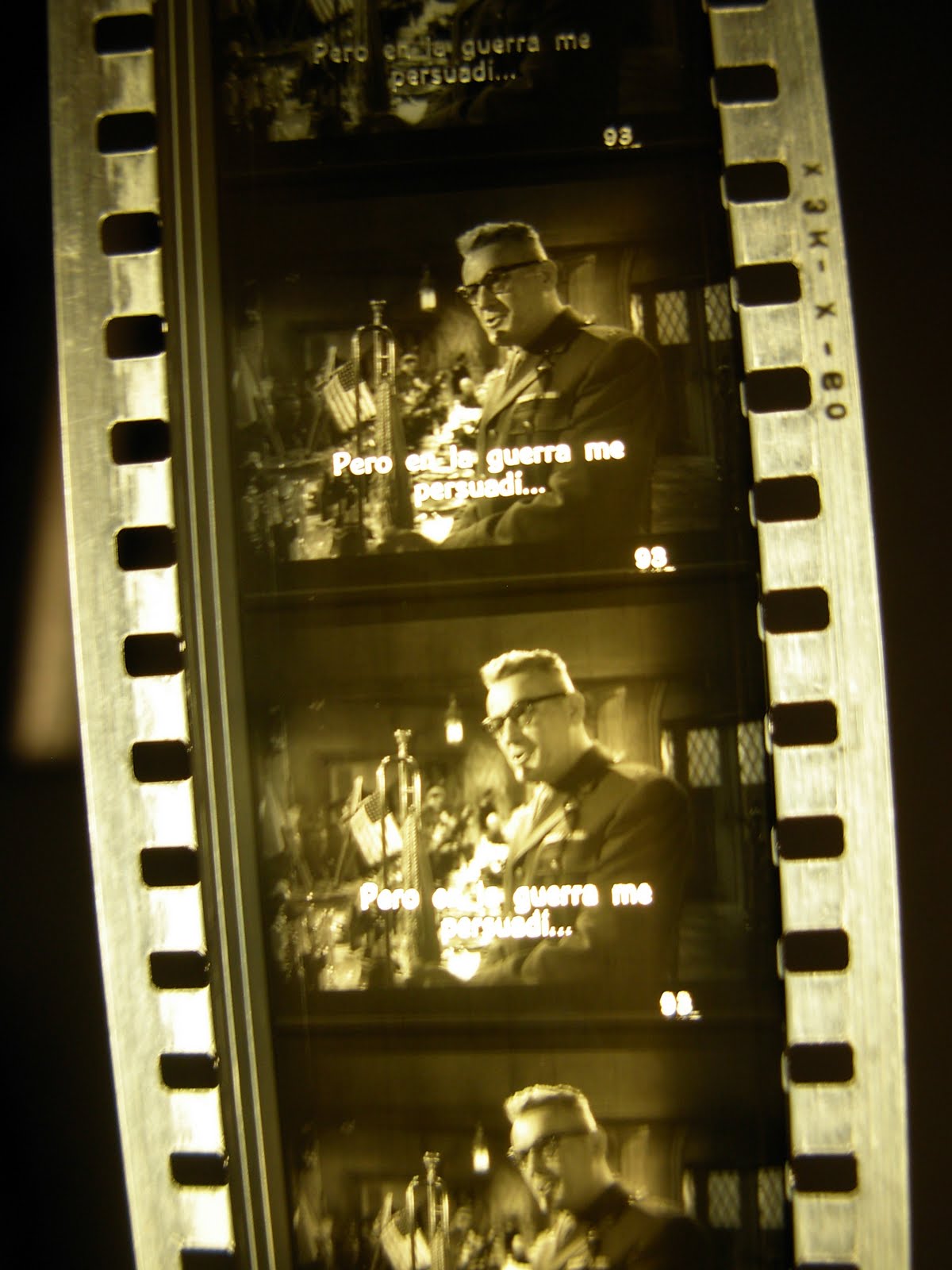
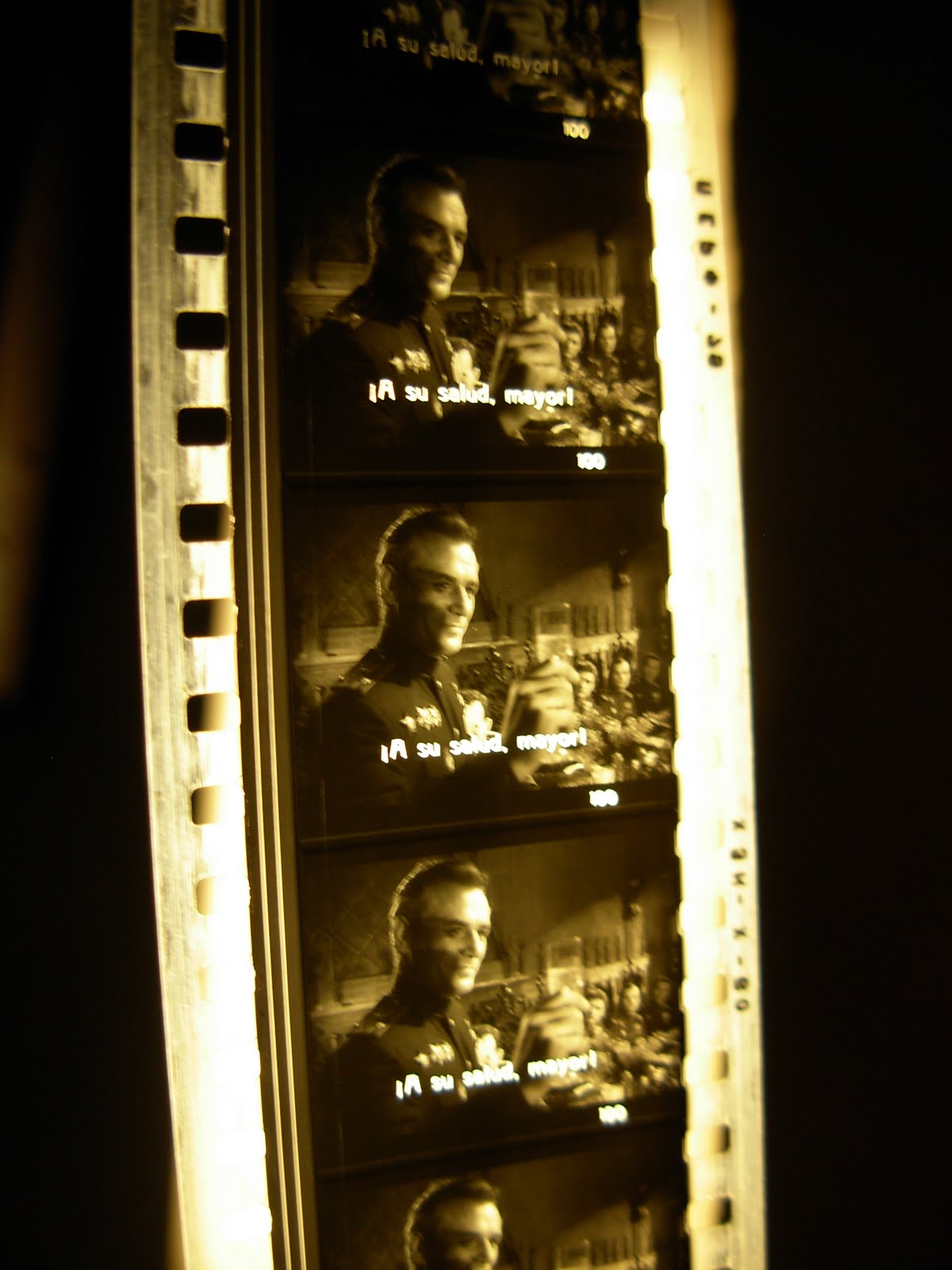
Here´s all the information I have of one 1,500ft long (approx) reel of film that I have recently purchased.
Any and all help will be greatly apreciated.
.
- It is a #3 reel from a feature.
- Black and white.
- Dialogues are in Russian.
- (Subtitled in Spanish)
- Triacetate base.
- Mono sound.
- Stock seems to be Gevaert from Belgium, copied from Kodak stock (date code: 2 triangles, most likely 1941).
- Label on the can reads Sovexportfilm, with no markings on it except for a "3" that I assume belongs to the reel # and a "Исп" which I assume is short for Испанский (Spanish), which leads me to believe that it was subtitled in the USSR.
![]() |
| "Vivíamos en la misma calle en Leningrado" (We used to live on the same street in Leningrad) |
![]() |
| "Pero en la guerra me persuadí..." (But during the war, I was persuaded that...) |
![]() |
| "A su salud, Mayor." (To your health, Major) |
Any and all help will be greatly apreciated.
.
Subscribe to:
Posts (Atom)