Showing posts with label 35mm Film. Show all posts

20 Apr 2011

DISCONTINUED PROCESSES: VistaVision


VistaVision is a higher resolution, widescreen variant of the 35mm motion picture film format which was created by engineers at Paramount Pictures in 1954.

VistaVision was Paramount´s response to 20th Century Fox´s Cinemascope, which in turn was devised with the intention of stealing some of the crowds that were drawn to the few Cinerama theatres available in the world. It seemed that widescreen features were the answer to Hollywood´s prayers to try and lure audiences back into the theatres and away from the new technological threat: the TV set.

The soul of the VistaVision process was 35mm film, but travelling horizontally in the gate (instead of vertically) at eight sprocket holes per frame (instead of 4), giving a negative image area nearly three times bigger than the standard negative aperture.

The process included new wider angle lenses to give greater scope on the big screens and PERSPECT-A STEREOPHONIC SOUND. This type of sound was comprised of a single photographic sound track located in the standard position so that they will reproduce on any standard optical sound head in any projector the world over. What made it PERSPECT-A, was the use of frequencies below 30Hz as modulated control signals that assigned a certain sound source -one of the speakers located throughout the audiorium- to different parts of the soundtrack.

One of the design breathroughs of the PERSPECT-A system was that the sound control units had an automatic return to monaural sound in case of trouble. Today that is mainstream with all digital 35mm sound formats.

"All release prints will have a single photographic sound track that will play on every standard sound reproducer the world over. Paramount does not contemplate the release of any pictures with either a separate or four-track magnetic film. Further, Paramount does not contemplate releasing any prints having the Fox-Eastman narrow sprocket holes."
"PESPECT-A SOUND will expand music to multiple loudspeakers and control the direction of the sound source when and as it is required for dramatic effectiveness. Paramount suggests this type of sound for those exhibitors who desire multi-horn reproduction and who wish to fill the theater with sound. The present experience indicates that stereophonic sound is of questionable value in the smaller theaters. It may add to the effectiveness in large theaters with very large screens. The decision as to its use rests with the exhibitor. In selecting Perspect-a-Sound for VistaVision pictures, Paramount is moving toward standardization. It is our hope that we can gain complete compatibility with M.G.M., Warners and others."
The VistaVision process did not introduce any modifications to the everyday 35mm exhibition print. It was merely a capture process to preserve the optical sharpness and contrast of the original negatives to produce better quality prints. It was processed by Technicolor and optically reduced directly from the negative to the Technicolor matrix which in turn was used to stamp out the release print by the imbibition process.

This gave a wider aspect ratio of 1.5:1 versus the conventional 1.37:1 Academy ratio, and a much larger image area. In order to satisfy all theaters with all screen sizes, VistaVision films were shot in such a way that they could be shown in one of three recommended aspect ratios: 1.66:1, 1.85:1 and 2.00:1.

Loren L. Ryder, chief engineer at Paramount, expressed four general reasons why he thought Paramount's VistaVision would be the forerunner of widescreen projection in most theaters:

  1. VistaVision could be shown at widescreen aspect ratios between 1.66 to 2.00:1.
  2. VistaVision could be (and most often was) further printed down to standard vertical 35mm reels keeping its 1.66:1 widescreen aspect ratio, which meant exhibitors did not need to purchase additional projection equipment, unlike CinemaScope.
  3. VistaVision did not cut down the number of seats in any theater (such as Cinerama and CinemaScope).
  4. VistaVision allowed patrons to see more and therefore gain more enjoyment out of a feature.
After months of trade screenings, Paramount introduced VistaVision to the public at Radio City Music Hall on October 14, 1954, with their first film shot in the process, "White Christmas".

"White Christmas", "Strategic Air Command", "To Catch a Thief" and "The Battle of the River Plate" had very limited (two or three) prints struck in the 8-perf VistaVision format in which they were shot. Although the clarity of these 8-perf prints was striking, they were used only for premiere or preview engagements between 1954 and 1956 and required special projection equipment. This exhibition process was impractical because for the footage to travel through a projector at the normal 24 frames per second, the film had to roll at 3 feet per second, double the speed of 35 mm film and causing many technical and mechanical problems. Aside from these prints all other VistaVision films were shown in the conventional 4-perf format, as planned.

Alfred Hitchcock used VistaVision for many of his films in the 1950s. However, by the late 1950s with the introduction of finer-grained color stocks and the disadvantage of shooting twice as much negative stock, VistaVision became obsolete. Paramount dropped the format after only seven years, although for another forty years the format was used for high resolution special effects sequences. Less expensive anamorphic systems such as Panavision and the more expensive 70 mm format became standard during the later 1950s and 1960s.

List of all Films Shot in VistaVision

Sources:
Wikipedia
Widescreenmuseum.com

19 Apr 2011

THE EVOLUTION OF DOLBY FILM SOUND

Going to the movies today is more exciting and involving than ever before, thanks in large part to a continuing effort to improve film sound undertaken by Dolby Laboratories in the early 1970s. Indeed, the history of cinema sound over the past two decades closely mirrors the history of Dolby film sound technologies.

Optical soundtracks

The photographic, or “optical,” soundtrack was the first method of putting sound on film. Today it remains the standard, in both analog and digital forms. The classic analog optical soundtrack consists of an opaque area adjacent to the picture containing narrow, clear tracks that vary in width according to variations in the sound. As the film is played, a beam of light from an exciter lamp or LED in the projector’s soundhead shines through the moving tracks. Variations in the width of the clear tracks cause a varying amount of light to fall on a solar cell, which converts the light to a similarly varying electrical signal. That signal is amplified and ultimately converted to sound by loudspeakers in the auditorium.

Economy, simplicity, and durability are among the advantages that have contributed to optical sound’s universal acceptance. The soundtrack is printed photographically on the film at the same time as the picture and can last just as long, which— with care—can be a long time indeed. And the optical soundhead within the projector is itself economical and easily maintained.

Success gets in the way of progress

Motion pictures with sound were first shown to significant numbers of moviegoers in the late 1920s. Within a few years, many thousands of theatres were equipped to show “talking pictures” with optical soundtracks.
This phenomenally rapid acceptance of a new, sophisticated technology was not without drawbacks, however. Equipment was installed in cinemas so rapidly that there was no time to take advantage of the improvements that occurred almost daily. A good example is loudspeaker design. The first cinema loudspeakers had very poor high-frequency response. Speakers with superior response became available within just a few years, but there was no time to retrofit the original systems with new units.

Engineers were too busy equipping other cinemas with their first sound installations. This caused a dilemma for soundtrack recordists. Should the tracks be recorded to take advantage of the improved speakers, or should they be prepared to sound best on the many older installations already in place? Given that it was impractical to release two versions of a given title, the only alternative was to tailor soundtracks to the older speakers. The result was to ignore the improved high frequency response of the newer, better units.

To forestall compatibility problems, in the late 1930s a de facto standardization set in, the cinema playback response that today is called the “Academy” characteristic. Cinema owners knew what to expect from
the films, and therefore what equipment to install. Directors and sound recordists knew what to expect from cinema sound systems, and thus what kind of soundtracks to prepare. The result was a system of sound recording and playback that made it possible for just about any film to sound acceptable in any cinema in the world. The problem was that the system lacked the flexibility to incorporate improvements beyond the limitations that existed in the 1930s.

Magnetic striping and multichannel sound

In the early 1950s, as the film industry sought to woo viewers away from their fascinating new television sets, a new method of putting sound on film was introduced. After the picture was printed, narrow stripes of
iron oxide material (similar to the coating on magnetic recording tape) were applied to the release print. The sound was then recorded on the magnetic stripes in real time. In the cinema, magnetic prints would be played back on projectors equipped with magnetic heads similar to those on a tape recorder, mounted in a special soundhead assembly called a “penthouse.”

Magnetic sound was a significant step forward, and at its best provided much-improved fidelity over the conventional optical soundtrack. It also enabled the first multichannel sound reproduction, dubbed “stereophonic sound,” ever heard by the public. The voice of an actor appearing to the left, center, or right of the picture could be heard coming from speakers located at the left, center, or right of the new wide screens also being introduced at this time. Music took on a new dimension of realism, and special sound effects could emanate from the rear or sides of the cinema. The two main magnetic systems adopted were the four-track 35 mm CinemaScope system, introduced with The Robe, and the six-track 70 mm Todd-AO, first used for Oklahoma!

Magnetic falls into disuse

Magnetic sound was widely adopted in the 1950s. By the 1970s, however, when the film industry experienced an overall decline, the expense of magnetic release prints, their comparatively short life compared to optical prints, and the high cost of maintaining the playback equipment led to a massive reduction in the number of magnetic releases and cinemas capable of playing them. Magnetic sound came to be reserved for only a handful of first-run engagements of “big” releases each year. By the mid-1970s, then, movie-goers were again hearing low-fidelity, mono optical releases most of the time, with only an occasional multitrack stereo magnetic release. Ironically, just as the industry was reverting to mono optical, more and more moviegoers were enjoying better sound at home over superior hi-fi stereo systems.

Dolby gets involved

By the late 1980s, the situation that prevailed in the mid-1970s had completely changed. Thanks to new technology and a turnaround in the financial decline of the industry, almost all major titles by that time were being released with wide-range multichannel stereo soundtracks, as is the case today. The breakthrough was the development by Dolby Laboratories of a highly practical 35 mm stereo optical release print format originally identified as Dolby Stereo. In the space allotted to the conventional mono optical soundtrack are two soundtracks that not only carry left and right information as in home stereo sound, but are also encoded with a third center screen channel and—most notably—a fourth surround channel for ambient sound and special effects.

This format not only enabled stereo sound from optical soundtracks, but higher-quality sound as well. Various techniques were applied to the soundtrack during both recording and playback to improve fidelity.
Foremost among these was Dolby A-type noise reduction to lower the hissing and popping associated with optical soundtracks, and loudspeaker equalization to adjust the cinema sound system to a standard
response curve.

As a result, stereo optical prints could be reproduced in cinemas installing Dolby cinema processors with far wider frequency response and much lower distortion than conventional soundtracks. In fact, the Dolby optical format led to a new worldwide playback standard (ISO 2969) for wide-range stereo prints.
An important advantage of the Dolby optical format was that the soundtracks were printed simultaneously with the picture, just like mono prints. Thus four-channel stereo optical release prints cost no more to make than mono prints, and far less than magnetic prints. In addition, conversion to stereo optical proved relatively simple, and once the equipment was installed, very little maintenance was required. The result was multichannel capability equaling that of four-track magnetic 35 mm (which soon became obsolete), with consistently higher fidelity, greater reliability, and far lower cost.

The next step: Dolby SR

In 1986, Dolby Laboratories introduced a new professional recording process called Dolby SR (spectral recording). Like Dolby noise reduction, it was a mirror-image, encode-decode system used both when a soundtrack is recorded and when it is played back. It provided more than twice the noise reduction of Dolby A-type, and, moreover, permitted loud sounds with wider frequency response and lower distortion.
The 35mm optical soundtracks treated with Dolby SR instead of Dolby A-type not only sounded superb in cinemas equipped with new SR processors, but also played back satisfactorily in all cinemas. This led to the situation today, whereby the analog soundtracks on virtually all prints are Dolby SR tracks.

The digital age begins

The next film sound development from Dolby Laboratories was Dolby Digital, introduced in 1992. Dolby Digital puts a six-channel digital optical soundtrack in addition to a four-channel SR analog track on 35 mm prints. This format is yet another significant step forward in film sound, providing independent left, center, right, left surround, and right surround channels, plus a sixth channel for bass effects. In addition to its six-channel capability, Dolby Digital provides extraordinary dynamic capability, wide frequency range, low distortion, and relative immunity to wear. Its combination of high quality, reliability, and practicality has been proved in cinemas around the world, and today it is the most popular digital format, with the most releases, and the most cinemas worldwide equipped to play them. As with previous Dolby developments, Dolby Digital did not make existing cinema installations obsolete. Prints can play conventionally in any cinema, while the digital track can be reproduced in cinemas with Dolby Digital soundtrack readers and decoders.

Dolby Digital Surround EX

The newest Dolby format, Dolby Digital Surround EX, was introduced in 1999, and adds a third surround channel to the Dolby Digital format. Enabling improved realism, more precise sound placement, and exciting
special effects, the third channel is reproduced by rear-wall surround speakers, while the left and right surround channels are reproduced by speakers on the side walls. As with all other Dolby soundtrack improvements, Dolby Digital Surround EX is backwards-compatible, with prints playable in all Dolby Digital cinemas, whether or not equipped to decode the additional surround track. To find films that use the new format and cinemas in your area equipped to play it, visit www.dolby.com/movies.

Making films sound better

Film soundtracks encoded with Dolby technologies, and the equipment for playing them, are only links in a chain that extends from the original location, through the dubbing theatre, to the processing laboratory, and
finally into the cinema. Developments like Dolby SR and Dolby Digital ensure that the soundtrack itself remains one of the strongest links. But the extreme fidelity of the latest Dolby formats can reveal the quality of each step in the recording, mixing, and dubbing processes, and this has necessitated new approaches to soundtrack production. Admittedly, the results can vary—the final reproduced soundtrack can be no better than the elements it comprises—but Dolby film sound at its best means not only better sound quality, but sound in the theatre that consistently realizes the director’s original intentions.

While Dolby Laboratories’ involvement with film sound first achieved wide recognition with the spectacular audio effects of such films as Star Wars, it has long since come to mean more than just special or dramatic effects. The objective is high-quality sound reproduction overall— from the dialogue and the score to the sound design and effects. Dolby technology is a means, not an end. It can be likened to an artist’s palette that provides the director with a full range of colors, where before there were but a few. Above all, Dolby formats have been developed to enhance that very special experience of going to the movies.

18 Apr 2011

MoMA´s Nitrate Facility

"AMERICAN PICKERS" Season 2 Episode 4: Smooth Operators

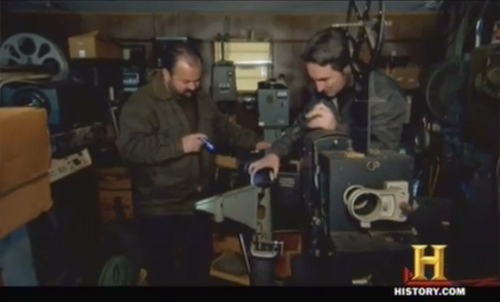
In my recent visit to the States, I came accross this episode of what to me was an unknown series: American Pickers. This particular episode (#4 from season 2) features the two presenters running into a woman (Michelle) who is sitting on a warehouse full of projection equipment.

Source of picture: coolandcollected.com
The equipment used to belong to her father, who passed away on 2010. His name was Bill Goff.  Michelle has contacted the guys over at Cinema Treasures where she placed an Ad and left her contact information, in case anyone is interested.

12 Apr 2011

FILM IDENTIFIED (IN RECORD TIME): "Первый день мира"

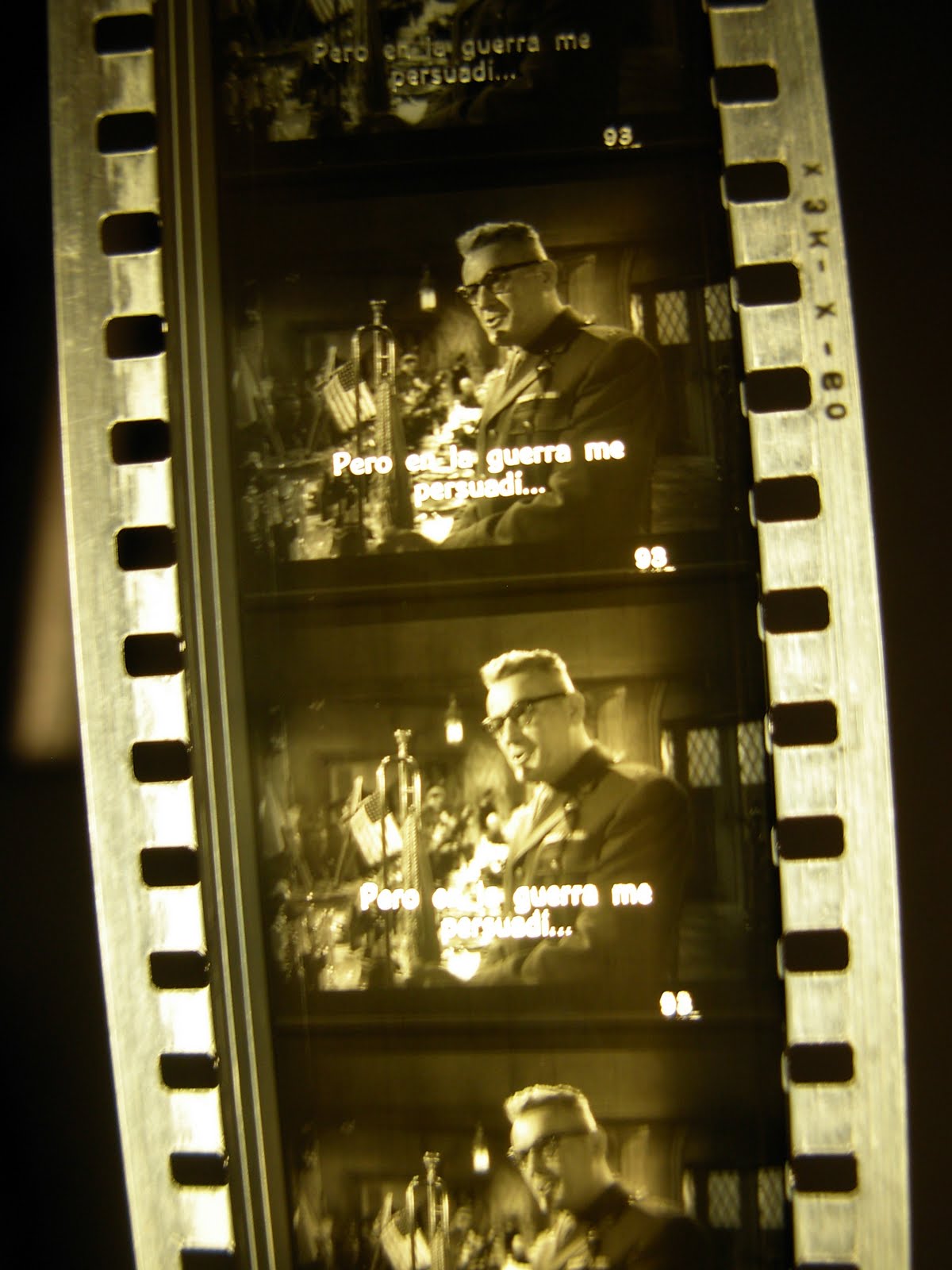
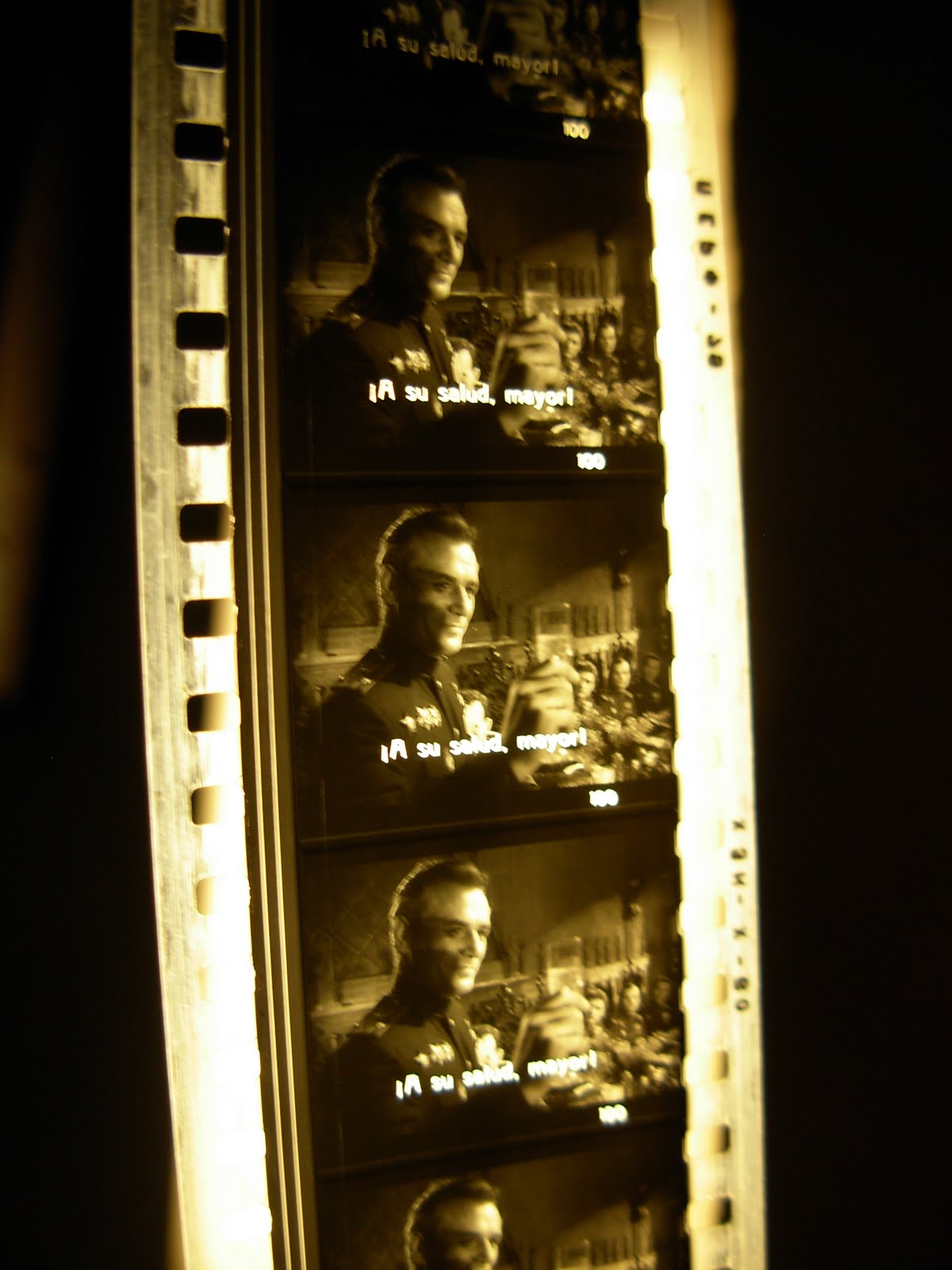
The stills shown in the previous post belong to the soviet film "Первый день мира" from 1959. Huge debt of gratitude to the scholars at Slavcin-L, who identified it. In the western world, the film seems to have been released under two titles: "The Day the War Ended" and "The First Day of Peace" which is the correct translation of the title. It was released on the 28th of January, 1961 in New York City, hence, some sites show it as a 1961 film.

You can find all information for the film, including cast and crew, opening dates and stills in the following links:


HELP IDENTIFYING SOVIET 35mm FILM

Here´s all the information I have of one 1,500ft long (approx) reel of film that I have recently purchased.
  • It is a #3 reel from a feature.
  • Black and white.
  • Dialogues are in Russian.
  • (Subtitled in Spanish)
  • Triacetate base.
  • Mono sound.
  • Stock seems to be Gevaert from Belgium, copied from Kodak stock (date code: 2 triangles, most likely 1941).
  • Label on the can reads Sovexportfilm, with no markings on it except for a "3" that I assume belongs to the reel # and a "Исп" which I assume is short for Испанский (Spanish), which leads me to believe that it was subtitled in the USSR.


"Vivíamos en la misma calle en Leningrado"
(We used to live on the same street in Leningrad)


"Pero en la guerra me persuadí..."
(But during the war, I was persuaded that...)


"A su salud, Mayor."
(To your health, Major)


Any and all help will be greatly apreciated.
.

29 Mar 2011

"TOUCH OF EVIL" (1958) Original Trailer

I´ve been catching up with Universal International´s neglected jewels. First I´ve started with this one, which, apart from the opening shot, I´ve never watched complete.


Differing versions (extracted from Wikipedia´s article)

1.- The original 1958 release version
2.- A longer version, released in 1976
3.- A 1998 restored version that attempted to follow Welles's 1958 memo as closely as possible.


Welles's rough cut as submitted to Universal no longer exists. This was worked on and trimmed down by Universal staff, and in late 1957 Universal decided to perform some reshoots. Welles claimed these were done without his knowledge, but Universal claimed that Welles ignored their requests to return and undertake further work. This was when Keller came aboard: some of his material was entirely new, some replaced Welles scenes. Welles viewed the new cut and wrote a 58-page memo to Universal's head of production, Edward Muhl, detailing what he thought needed to be done to make the film work. However, many of his suggestions went unheeded and Touch of Evil was eventually released in a version running 93 minutes.


In the mid-1970s, Universal discovered that it held a 108-minute print of Touch of Evil in its archives. Aware that there was a growing audience of cineastes with a strong interest in Welles' work, the studio released this version to cinemas in 1976 and later issued it on video, billing it as 'complete, uncut and restored'. In fact, this print was not a restoration at all, but a preview version which post-dated the Welles memo but pre-dated the release version. While it did feature some vital Welles scenes which had been cut from the release version, it also featured more Keller material: the new footage had been cut into the film, but much of it ended up being cut out again, resulting in pointless expense for Universal.


In 1998, the film was re-released in a re-edited form, which was based on the Welles memo and edited by Walter Murch, working from all available material, with Bob O'Neil (Universal's director of film restoration) and Bill Varney (sound engineer) participating in the restoration.[6] As Welles' rough cut no longer exists, no true 'Welles cut' is possible, but Murch was able to assemble a version incorporating most of the existing material, omitting some of the Keller scenes (though some were retained, either because they had replaced Welles scenes which no longer existed and were necessary to the plot, or because Welles had approved of their inclusion). In addition, some of Welles's complaints were concerned with subtle sound and editing choices, and Murch was able to re-edit the material accordingly.[7] Notable changes include the removal of the credits and music from the three-minute opening shot, crosscutting between the main story and Janet Leigh's subplot and the removal of Harry Keller's hotel lobby scene. Rick Schmidlin was the producer on the 1998 edit, which had a limited but successful theatrical release (again by Universal) and was subsequently made available on DVD. The DVD includes a reproduction of the 58-page memo.

AMC on Film Restoration - from 1993!

14 Mar 2011

A PIECE OF ROBERT A. HARRIS Part 5

What follows is the transcription of a fragment of an article intitled "Universal Upbeat in Studio Fire Aftermath" by Robert Marich for Broadcasting and Cable, published on June 20th. You can read the original here.


In February, 1993, a symposium was held by the National Film Preservation Board of the Library of Congress in Washington, D.C. to discuss the problem of the decay of motion pictures. Excerpted from the transcript of the February 26 testimony is this submission by film preservationist and restorer Robert A. Harris. Few people in the world have the ability to judge the condition of our film heritage as does Bob Harris. Working with David Lean, he gave us what is arguably the best presentation of Lawrence of Arabia ever seen, even after the original negatives and sound were considered to be virtually lost. With his equally fastidious partner, James C. Katz, Bob has worked miracles on the deteriorated likes of My Fair Lady, Spartacus, Vertigo, and Rear Window, not only saving these films from loss, but providing vivid new prints that rival the originals in many ways. Before placing this transcript in the American WideScreen Museum web site I asked Bob to review and update his statements. He altered one sentence. And that, boys and girls, says a lot about the condition of the films, good and bad, that many of us grew up with.


--------------------------------------------------------------------------------

Robert A. Harris' Statement at the Film Preservation Study:
Washington, D.C. Public Hearing, February 1993
We have all heard many times that we have already lost some 50% of the films made before 1950, that our nitrate heritage is slowly turning to powder before our eyes while budgets and time are running out. This is all true. However, with little mention of our post-1950s film this perpetuates the myth that film preservation is dedicated to our remote past, something that belongs more in museums than on theater screens.


Robert Harris and David Lean during the restoration of Lawrence of Arabia
Further, it gives the impression that all of these nitrate films simply decomposed while attempts were being made to preserve them. This is untrue. Most of the early films did not survive because of wholesale junking by the studios. There was no thought of ever saving these films. They simply needed vault space and the materials were expensive to house. There also seems to be a feeling that we must save it all. Like art and the written word, there was as much junk film produced during the first half of the century as is being produced currently. I made one of those in 1987, a junk film, which we can add to the pile of junk. It simply is not all worth saving with today's limited funding.

If our greatest problem were nitrate, then my chosen work in the archival field would be incomparably simple. But it is not. In 1988, while completing work on David Lean's Lawrence of Arabia, I was asked to look into Tom Jones, the 1963 Academy Award-winning Best Picture, newer than Lawrence by only one year. Try as I did searching vaults worldwide, the best I could come up with was a single dye-transfer Technicolor print with an Italian soundtrack. It was so worn that it could not be used for duplication.

I was told that the feeling when Tom Jones was in post-production was that it would not amount to anything. A judgment call. UA never made protection separations to back up the original negative. Today, a proper print of Tom Jones cannot be produced.

Although I do not necessarily have the answers to our preservation problems, I can at least raise or help reevaluate some of the questions.

Since the early fifties, we have been dealing with the Eastmancolor negative. There is nothing inherently wrong with this material except that it fades. We have lost the original negatives to many important films of the fifties, and we are now going into the sixties; films of the seventies are now showing signs of fading.

Lawrence, a 1961-62 production photographed in Eastmancolor and processed by Technicolor London was fortunate. For some reason, the work done at that particular laboratory seems to survive years longer than film processed elsewhere, possibly the water from the Thames, I am not sure. Lawrence was still in good enough shape, although the negative was cracked and falling to pieces, that new color protection materials could be produced. We could not produce new black-and-white protection material, because the negatives would not run three times to produce separations.

The camera negative on Universal's 1960 Spartacus was totally faded, totally unusable. Nothing could be done to produce any printing material from that element. We worked from black-and-white separations and had to create the equipment to manufacture a 65mm preservation internegative on the film. We worked from the seps but those seps had been produced defectively. They had been vaulted 30 years before and never tested. I will not go into the problems that were encountered, but the lesson learned was simple and dramatic: black-and-white master separations, when produced, were routinely vaulted and forgotten, assuming they would yield beautiful results when needed. We now know that this simply is not accurate in all cases.

No one knows what materials can be produced from separation masters unless they have been printed, not selectively tested or reviewed on a Rank [film-to-tape transfer machine], but printed. This should be done before the negatives that they protect are no longer viable printing elements. If the protection is defective and the negatives have gone, nothing further can be done. Without doing so, we may have no protection for the last 40 years of color film history. Every film worth saving which has not been backed up should be looked into with immediacy.

The large format films, 70mm, Technirama, etc., are in the highest risk group. Since most 70mm prints were made directly from the camera negatives, many are extremely worn. Most large format masters are untested. They probably will not register very well and they generally are not backed up by large format color interpositives of any vintage no less recent.

My single hard and fast rule is do not rejuvenate original negatives; and this keeps happening continuously in laboratories around the world. Do not put chemicals on preservation materials. This will go against everything that you will hear if there are people coming here representing rejuvenation and scratch-removal vendors. They will tell you that the panacea for saving our film heritage is to coat it with chemicals.

There is a problem right now with the original camera negative of a very well-known 1968 film. Someone allowed the negative to be chemically treated and a lab wetgated the footage. That film is now a solid block. We are trying to ease it apart and remove the coating without the emulsion coming off.

Rejuvenation causes film to shrink, warp and shed its emulsion. Particles of dust and dirt are caught under the coatings and become a part of the picture never envisioned by the director of photography.

The overall quality of preservation work done by some vendors is a joke. What they produce is generally in the "good enough to get us paid" category. Once materials are delivered, they are generally accepted. Although much preservation material was produced before the advent of wetgate printing and therefore wear was more apparent, there were still materials produced after this process was available, which just was not done professionally.

If someone 15 or 20 years ago had made decent materials on pictures like Casablanca, they would look a lot better than they do today, and they would not have to be constantly redone. There are not adequate materials produced on hundreds of films; but there are materials. You can generalize that the more popular the film, the worse shape it is going to be in. Quality is a problem that has been with us for decades.

Nitrate is preserved once, then again and then possibly a third time, hopefully the right way. Original negatives are sometimes pulled to create non-preservation elements to be used for a video transfer. This places wear and fade on the negative without accomplishing anything.

One final point on this subject. Once materials are preserved properly, that does not then mean that the original nitrate should be junked. I have to assume that today's technology will be constantly supplanted in the future with new means of creating even higher quality preservation materials. You never want your finest surviving asset to be a dupe when you can have the luxury of going back to an original element.

If someone asked what I would do if I could selectively control all film preservation except that being done by the few studios and archives who are doing it correctly, my initial answer would be very simple: nothing. I would shut it down completely. Vendors should be checked for quality and accredited to do preservation work rather than just offering it on rate cards. Preservation work should not be synonymous with lab work. Simply producing a set of separation masters does not mean that a film is preserved. Producing a finegrain from a nitrate original does not mean that it is preserved. All these materials have to be produced correctly not just produced, shipped and billed.

There are too many situations in which the wrong material is produced from the wrong material. This does nothing more than spend preservation dollars for masturbatory or "voodoo" preservation. All this junk has to be stored, placed on databases and occasionally checked but it will always be junk. Years from now, someone will come along and wonder why it was produced but the good materials will already be gone. Once all these problems were solved, then I would start the wheels turning again.

Some people who work in preservation do not know what a preserved or restored film should look and sound like. This is exacerbated by the fact that few titles have an original print. Without a reference print, you have no idea what the intentions of the filmmakers were regarding color, density, contrast or even major points like "day for night" scenes. When a reference print is available, it may not be an approved print. It could well be left over from a reissue or have survived as a lab reject.

Work is accepted which should be rejected because some people are either too lazy or just not knowledgeable enough to know what to do. People with a background in business as well as film history, film elements and lab techniques should be running motion picture asset protection programs.

Studios and rental vaults are now placing inventory on computer. Sometimes, as in the case of Universal, people actually open cans, inspect and listen to material. However, all too often these inventories are simply perpetuated error. An element is incorrectly listed on a label, insecurely attached to a can, then transferred to a card, and then years later, from the card to computer by someone who cannot quite decipher the original handwriting. All of this with never a look back at the actual materials, especially if they are in another country or vaulted underground.

There have been too many occurrences in which I have called someone to see if they have protection on a long version or stereo tracks, only to be told that the film was monaural or that there was no long version. It is simply bad recordkeeping.

If we are going to really start taking all this seriously, now is probably a good time to begin. If we do not, here is what we can do. Make a list of films produced since 1953, then draw a line around 1965. That is the date before which it is safe to assume we will not be able to protect anything much longer unless it is already protected.

Take a look at the titles and then dismiss every great film that you would like to share with your children or grandchildren or possibly just see again. They are not going to be there when we want them. It is all as simple as that. Either we do something now and do it right or let's forget it all. It will soon be just so much junk.

6 Mar 2011

A PIECE OF ROBERT A. HARRIS Part 4

Vertigo - A Smash-Hit Down Under!

Was it worth the more than one million dollars that it cost to restore Alfred Hitchcock's classic film, Vertigo.

The answer has to be an unqualified yes if the crowds that turned up to see the 70mm release at The Astor Theatre in Melbourne, Australia, are any guide.

More than 2,000 people were there for the first three screenings on a Sunday in late September - there were close to 1,000 in the audience at the late show alone!

By the end of the three-week run the results were the best The Astor had achieved for any re-release. In fact, they were nearly as good as those for the 70mm version of Hamlet. And that screening at The Astor broke all national, season-average records for a first-run release.

Vertigo also played in Sydney. It did well there although the figures were not as good as those for Melbourne which did 50% better in half the time.

The audiences were almost as fascinating as the film. Some were Hitchcock aficionados while others were simply intrigued by the Hitchcock legend. Many had seen the film some 30 years ago and wanted to see it presented in 70mm - a close as possible to how Hitchcock had meant it to be seen.

The Astor is superbly equipped for doing just that (see the August, 1997, issue of Wide Gauge). And it is the only cinema in Melbourne capable of screening the Vertigo restoration with 70mm DTS sound.

There was an almost-palpable sense of expectation as the film started. The screen masks, fully-open at 2:1 for the Universal logo, closed to about 1.8:1 when the old VistaVision logo appeared. It was faded and washed-out with a slight colour-cast. It looked as though it might have been the original logo left unrestored as a contrast to what was to follow.

And the first scenes, with James Stewart running across the roof-tops, had many people catching their breath.

It was clear that it was a restoration, that it was not an original, Technicolor print. There was a certain softness and, sometimes, the colours seemed somewhat pastel in nature. But the superb quality of the restoration became blindingly obvious during those few sequences for which the colour separations had deteriorated too much - the restorers had been forced to resort to the camera negative. The sheer detail and apparent accuracy of the colour must leave one in awe of the work done by Robert Harris and James Katz.

The full, 70mm frame was being projected so nothing of the image on the film was lost. It was most-interesting to see the VistaVision framing marks.

The 70mm DTS sound was stunning and, clearly, vastly superior to the original. The use of the surround and screen-effects channels was particularly effective during the driving sequences when vehicles in the background crossed from one side of the screen to the other.

There was a sync problem during the first reel with the sound leading the picture but it corrected itself after a while. It happened at every screening and appears to have been caused by errors in the time-code on the print.

One particular thing about the sound that caught the attention was the fact that music sometimes continued uninterrupted as the reel-change cue-marks appeared.

At The Astor, film from the shipping reels is combined to make-up 4,000-foot reels so not every set of cue-marks is at the physical end of a projection reel. But there were some continuing effects and music at actual change-overs.

The owner, manager and chief-projectionist of The Astor, George Florence, had noted them while previewing the print. He found that it was possible to change projectors with no discernible jump in the sound if the film was cued-up accurately and the change-overs made exactly on cue.

It is possible that Universal expected Vertigo to be shown using platters instead of reels - a view supported by the fact that some of the shipping reels had some very-odd film lengths. One, for example, had just eight minutes worth.

One thing that did give Florence some concern was the lack of audio back-up - there was only one set of discs and, of course, no fall-back sound-track on the film. However, he is certainly well aware of the huge financial and logistic benefits to be gained by producing in 70mm DTS instead of mag-stripe.

Leaving the technical aspects aside for a moment, how did the audiences react to the film?

Many people seeing Vertigo for the first time were expecting nail-biting suspense. But that's not what Vertigo is all about. It is a disturbing rather than a suspenseful movie - a story of obsession. Hitchcock meant to leave audiences with a feeling of disquiet. It certainly achieved that although there were several instances where the "dated" nature of some of the scenes gave rise to gentle, but not unkind, laughter.

Those who had seen Vertigo before were stunned - they felt that the 70mm restoration was much better than the 35mm screenings they had seen. Memories were sometimes a little hazy but everybody commented on the bigger screen-image and on the superb sound. As one member of the first-night audience put it, "I now feel that I had never really seen Vertigo until tonight."

It is noteworthy that most of the audience stayed to watch the closing credits which gave some insight into the work and the people involved in the restoration.

George Florence is obviously excited about the success of the Vertigo restoration. He hopes it will spur film-company executives to put up the money for the preservation or restoration of other wide-format films - there are undoubtedly enough of them in need of it!

He is certainly looking forward to the 1999 release in 70mm DTS of the Harris/Katz restoration of Rear Window. And he is looking at the possibility of getting new prints of some of the classics in 70mm DTS.

He also hopes that the digital system will encourage film makers to use the wide format. "The major cost with 70mm," Florence says, "has been adding the mag-striping and then recording the sound reel by reel. With DTS the cost of a 70mm print could be brought down to about three times that of a 35mm print instead of something like twelve times the cost."

As Scott Marshall, the Editor of Wide Gauge, put it, "That would be a nice side effect. I think that digital sound these days is so fine that it's starting to make the picture look bad in comparison. That's a surprise reason why digital sound may encourage large formats. It was previously thought to discourage them because it was assumed that mag tracks were 70mm's only advantage."

The Vertigo print went from The Astor to a, possibly-ambitious, five-week run in Adelaide, the capital city of the state of South Australia. It will then be screened in three other capital cities before returning to Melbourne and The Astor in February.

George Florence says he expects to get good houses at the second run of Vertigo as well. "Melbourne people seem to like nostalgia and classic films," he says. "And they are becoming increasingly aware of the advantages of wide-format presentations."

Apart from the return of Vertigo, The Astor's audiences can look forward to more screenings of the 70mm version of Hamlet, a new 70mm print of 2001 in December, the Harris/Katz 70mm restoration of Lawrence of Arabia at Christmas and a new 70mm mag-stripe print of Ben Hur next Easter.

"But," says Florence, "if I had known six months ago, when I was doing the deal, how successful 70mm DTS would be I would have ordered Ben Hur in that format instead of in mag-stripe and saved a bundle!"

© Copyright 1997 Ralphe Neill
Melbourne, Australia

ran@sub.net.au

(This article was first published in the October, 1997, issue of Wide Gauge Film and Video Monthly in the US)

20 Feb 2011

10 Jul 2008

A PIECE OF ROBERT A. HARRIS Part 2

What follows is the transcription of an article intitled "Film Restoration: More than ´Rear Window´ dressing" written by Bill Desowitz for cnn.com, published on December 11th, 1997. You can read the original here

First "Vertigo" was brought back from oblivion; now the ever-popular "Rear Window" is the latest Alfred Hitchcock classic starring Jimmy Stewart being saved from the ravages of time.

To enhance its image quality, the restored version will be among the first films printed in Technicolor's new dye-transfer process (so far used only experimentally with a few prints of Warner Bros.' "Giant" reissue and "Batman & Robin").

This marks the third Universal Pictures restoration by the team of Robert Harris and James Katz, following "Spartacus" and "Vertigo." The "Rear Window" fix-up is less expensive the other large-format projects -- "Vertigo," for example, cost $1.3 million -- but no less intensive.

"Like 'Vertigo,' we can make 'Rear Window' look like it's never looked before, with rich colors to show off the new process," says Katz, who produces the restorations. "This serves the future without forgetting the past."

Indeed, as Technicolor gears up for next year's high-tech return of dye transfer (abandoned since the mid-1970s) -- which has suddenly become cost-effective in the current "event" film market -- the "Rear Window" announcement proves that the process can also accommodate special reissues as well.

According to Frank Ricotta, Technicolor's senior vice president of worldwide technical and engineering operations, the new process yields sharper, less grainy prints than conventional color positive prints, as well as "an extended tone scale resulting in blacker blacks, whiter whites and improved color rendition."

The restorers concur that the results are impressive.

"'Rear Window' is a dark-looking movie," Katz says. "And in the tests, we've been getting a lot of detail in the blacks you don't ordinarily see. There's also increased sharpness. You can see it in the bricks on the buildings (in the courtyard) and in the patterns on the dresses."

Actually, "Rear Window" has never looked as good as it could have, according to Harris, even during its initial release in 1954. That's because the first dye-transfer prints weren't made until the 1962 reissue, when they were badly timed and came out beige. "So this will be the first time we see the film's full-color spectrum," he says.

But first the restorers must clean up an extremely dirty negative, abused from the very beginning. "It's a mess," Harris says. "There were 400 runs off the camera negative before the end of 1954. We don't know why they didn't do it dye-transfer, which would have saved printing off the negative. This was reasonably unusual for the period. And we're missing 1,000 feet of negative."

It is ironic that "Rear Window" has suffered this fate, considering it was one of Hitchcock's personal favorites and his most successful film of the '50s. It was also the first movie from his peak Paramount period, which he eventually owned outright and later withdrew for a decade. When last reissued, in 1983, "Rear Window" grossed another $9.1 million for Universal, which acquired it from Hitchcock's estate.

Inspired by Cornell Woolrich's cunning short story about murder, voyeurism and confined spaces, the director was obviously at his crafty best. He had all the technical toys he desired at his disposal, plus two of his favorite stars, Jimmy Stewart and Grace Kelly. "Rear Window" was Stewart's favorite of the four films he made with the director.

Breakthrough made restoration possible
Yet were it not for a recent technological breakthrough conceived by the restorers and developed by Phil Feiner, executive vice president of Pacific Title film lab, a complete restoration of "Rear Window" would not have been achievable.

Besides the accumulation of dirt, pieces of the original Eastman color negative that were dupes (titles and optical effects) have faded in the yellow layer of emulsion due to aging and improper storage -- a malady that sooner or later strikes all color negatives from the early '50s through the '80s, when a more stable stock was introduced. This first- layer deterioration includes loss of contrast, blacks and shadows going blue and facial highlights turning, in the words of the restorers, "a lovely shade of crustacean."

Compounding "Rear Window's" problem is an additional reel of negative that had its yellow layer stripped off the emulsion when a lacquer that was applied and reapplied over the years to cover scratches was eventually removed.

"No one was malicious here," Katz says. "The film was a victim of its environment over the years. It doesn't stand alone. There are thousands of films out there like this. No one knew enough about the properties of emulsion or temperature control for color negatives."

The restorers were first stymied by the yellow-layer problem last year when trying to correct the revelatory flashback in "Vertigo." Frustrated by their inability to restore the sequence, they later approached Feiner about devising a solution for subsequent restorations.

Using test footage from "Rear Window" and the 1956 remake of "The Man Who Knew Too Much" (to be restored at a later date), Feiner spent six months implementing a cost-effective photo- chemical solution.

To bring "Rear Window's" colorful brilliance back to life, an interpositive, an extremely fine-grain, low-contrast color- duplicating element, will be made from what survives on the original negative and combined with what survives on the yellow separation master.

"This is something that's going to benefit all of these pictures," Katz adds. "All the damage seems to be in the yellow layer."

'That shot is going to be breathtaking'
The most important moment in "Rear Window" to benefit not only from the yellow-layer breakthrough but from the new dye- transfer process is Kelly's seductive entrance -- which over the years has developed a yellow-green tint. Stewart, the aloof photographer confined to a wheelchair because of a broken leg, is awakened in his apartment by her tender kiss. To prolong the kiss and make it appear more sensual, Hitchcock shot it in close-up and then double-printed each frame in slow-motion.

"That shot is going to be breathtaking in Technicolor," Katz predicts. "When people first see her, they'll understand why everyone who came into contact with her fell in love with her."

The main title sequence, another casualty of yellow-layer fading, has already been repaired. "We used five different formulas to get the precise color for the main titles," Harris says. "There's a kind of Chinese red drop shadow that was difficult to reproduce. We finally got one that was acceptable using the yellow-layer method."

The original Paramount logo, incidentally, will return to the film's beginning and end, linked, of course, with the rising and falling bamboo shades in Stewart's apartment.

While "Rear Window" lacks the stunning visual reputation of "Vertigo," its technical virtuosity is legendary, boasting Hitchcock's most elaborate set to re-create the Greenwich Village apartment complex where Stewart spies on his neighbors with his telephoto lens. The effect, as Francois Truffaut first observed, is like viewing ambiguous scenarios of love and marriage from tiny movie screens or TV sets.

It was all part of Hitchcock's famous "pure cinema" scheme: creating tension between Stewart observing and being observed -- and involving us in the suspense of waiting for him to get caught. In fact, the way he introduces Stewart and his neighbors through a series of serpentine camera movements is as succinct an example of visual exposition ever filmed.

"People don't ordinarily think of 'Rear Window' as a stylish movie," Katz says. "But what we're discovering is that there is a style in the way Hitchcock used color. With Miss Lonelyhearts, we can now see the mauve in her apartment and the green in her dress. Each apartment has its own color style."

Harris and Katz expect the restoration to be completed next spring. However, Universal's distribution plans could be complicated by a blackout in place until 1999, coincidentally, the centenary of Hitchcock's birth. Sheldon Abend, who owns the copyright on the Woolrich short story from which the film is based, won a landmark U.S. Supreme Court decision in 1990 declaring his copyright renewal was violated.

"The important thing is, we're saving another Hitchcock," Katz adds. "And we have a whole new audience right now for this."


7 Jul 2008

6 Jul 2008

NEWS FROM YARDS AWAY

What follows is the transcription of an article intitled "Key Scenes Rediscovered" published on July 2nd on ZEITmagazin.com. You can read the original here.

Key scenes from Fritz Lang’s “Metropolis” have been rediscovered

Last Tuesday Paula Félix-Didier travelled on a secret mission to Berlin in order to meet with three film experts and editors from ZEITmagazin. The museum director from Buenos Aires had something special in her luggage: a copy of a long version of Fritz Lang’s Metropolis, including scenes believed lost for almost 80 years. After examining the film the three experts are certain: The find from Buenos Aires is a real treasure, a worldwide sensation. Metropolis, the most important silent film in German history, can from this day on be considered to have been rediscovered.

Fritz Lang presented the original version of Metropolis in Berlin in January 1927. The film is set in the futuristic city of Metropolis, ruled by Joh Fredersen, whose workers live underground. His son falls in love with a young woman from the worker’s underworld – the conflict takes its course. At the time it was the most expensive German film ever made. It was intended to be a major offensive against Hollywood. However the film flopped with critics and audiences alike. Representatives of the American firm Paramount considerably shortened and re-edited the film. They oversimplified the plot, even cutting key scenes. The original version could only be seen in Berlin until May 1927 – from then on it was considered to have been lost forever. Those recently viewing a restored version of the film first read the following insert: “More than a quarter of the film is believed to be lost forever.”

ZEITmagazin has now reconstructed the story of how the film nevertheless managed to survive. Adolfo Z. Wilson, a man from Buenos Aires and head of the Terra film distribution company, arranged for a copy of the long version of “Metropolis” to be sent to Argentina in 1928 to show it in cinemas there. Shortly afterwards a film critic called Manuel Peña Rodríguez came into possession of the reels and added them to his private collection. In the 1960s Peña Rodríguez sold the film reels to Argentina’s National Art Fund – clearly nobody had yet realised the value of the reels. A copy of these reels passed into the collection of the Museo del Cine (Cinema Museum) in Buenos Aires in 1992, the curatorship of which was taken over by Paula Félix-Didier in January this year. Her ex-husband, director of the film department of the Museum of Latin American Art, first entertained the decisive suspicion: He had heard from the manager of a cinema club, who years before had been surprised by how long a screening of this film had taken. Together, Paula Félix-Didier and her ex-husband took a look at the film in her archive – and discovered the missing scenes.

Paula Félix-Didier remembered having dinner with the German journalist Karen Naundorf and confided the secret to her. Félix-Didier wanted the news to be announced in Germany where Fritz Lang had worked – and she hoped that it would attract a greater level of attention in Germany than in Argentina. The author Karen Naundorf has worked for DIE ZEIT for five years - and let the editorial office of ZEITmagazin in on her knowledge.

Among the footage that has now been discovered, according to the unanimous opinion of the three experts that ZEITmagazin asked to appraise the pictures, there are several scenes which are essential in order to understand the film: The role played by the actor Fritz Rasp in the film for instance, can finally be understood. Other scenes, such as for instance the saving of the children from the worker’s underworld, are considerably more dramatic. In brief: “Metropolis, Fritz Lang’s most famous film, can be seen through new eyes.”, as stated by Rainer Rother, Director of the Deutsche Kinemathek Museum and head of the series of retrospectives at the Berlinale.

TEIL 2
Helmut Possmann, director of the Friedrich-Wilhelm-Murnau Foundation, the holder of the rights to “Metropolis”, said to ZEITmagazin: “The material believed to be lost leads to a new understanding of the Fritz Lang masterpiece.” The Murnau Foundation now sees itself as “responsible, along with the archive in Buenos Aires and our partners for making the material available to the public.”

The rediscovered material is in need of restoration after 80 years; the pictures are scratched, but clearly recognizable. Martin Koerber, the restorer of the hitherto longest known version of “Metropolis”, who also examined the footage, said to ZEITmagazin: “No matter how bad the condition of the material may be, the original intention of the film, including all of its minor characters and subplots, is now once again tangible for the normal viewer. The rhythm of the film has been restored.”

And perhaps the scratches, which will probably remain even after restoration, will have an added advantage: The cinemagoer will be reminded of what an exciting history this great film has had.

19 Jun 2008

"CLASSIC FILMS LOST ON UNIVERSAL STUDIOS FIRE"

What follows is a transcription of an article intitled "Classic Films Lost on Universal Studios Fire" written by John Horn and Susan King for the LA Times and published on June 4th. You can read the original here.

Destruction of the copies could affect several
upcoming screenings at museums and other sites.

By John Horn and Susan King, Los Angeles Times Staff Writers
June 4, 2008

In addition to the ruined "King Kong" attraction and the burned New York street scapes, the Universal Studios Hollywood fire has claimed another casualty: perhaps hundreds of classic 35-millimeter film prints, the studio said Tuesday.

The prints were high-quality copies of decades-old movies, not original masters, which are stored in a Philadelphia vault, the studio said. But the loss of the copies in Universal's scorched vault building, which the studio had not yet quantified, could affect several upcoming screenings of classic films at museums, festivals and repertory theaters.

"It's a real shame. The timing couldn't be worse," said Bernardo Rondeau, the coordinator of film programs at the Los Angeles County Museum of Art. As part of July's "The Discreet Charm of Charles Boyer" program, LACMA was scheduled to show the French-born actor's 1941 film "Hold Back the Dawn."

The print of that movie, which was originally released by Paramount but is part of Universal's archival collection, was being transferred from New York's Lincoln Center to the Los Angeles museum and may have been in the Universal vault when the predawn blaze broke out Sunday.


Making new film prints can cost $5,000 or more each and take months to produce.

The fire also claimed about 5% of Universal Music Group's recordings, primarily big band and jazz recordings on the Decca label, and video copies of Universal movies and television shows. Universal Music Group is no longer part of the NBC conglomerate but rents storage space from the studio.

LACMA's Rondeau said the museum was nearly finished preparing the schedule for its July 11-26 festival and still planned to include "Hold Back the Dawn" on the slate, hoping that the film was spared or that a substitute print could be located.

In an e-mail sent to several dozen film exhibitors Monday, Universal said the "fire destroyed nearly 100% of the archive prints kept here on the lot. Due to this we will be unable to honor any film bookings of prints that were set to ship from here. Over the next few weeks and months, we will be able to try and piece together what material we do have and if any prints exist elsewhere."

Jan-Christopher Horak, the director of UCLA Film and Television Archive, said that in addition to the uncertainty surrounding "Hold Back the Dawn," the status of several other classic film prints was murky but not as bad as once feared.

"Initially, with the flood of e-mails [asking for prints], the situation seemed more dire than it turned out to be," Horak said. "Universal did find prints on some stuff."

American Cinematheque, which operates the Egyptian Theatre and Aero Theatre, had booked prints of "Her Jungle Love" and "Aloma of the South Seas" (both Paramount films with Dorothy Lamour), and now Universal will not be able to provide the 35-millimeter prints, Horak said.

"It is upsetting," said Horak, who once worked at Universal. "I feed bad for my colleagues at Universal. I was in that vault. It was filled with stuff. It's going to take quite a while to assess what really was lost."

Text and photos copyright of their respective owners.

11 Jun 2008

A PIECE OF ROBERT A. HARRIS Part 1

What follows is the transcription of an article by Stephanie Argy and Rachael Bosley for the ASC Magazine. The original can be found here

BEFORE:


AFTER:

Widely regarded as an American classic and a landmark achievement in cinematography, Paramount Pictures’ The Godfather (1972) is identical to most films of its era in one respect: it was not properly preserved. Paramount, like most Hollywood studios, did not create a preservation program — “asset protection” in industry parlance — until the home-video boom of the 1980s proved film libraries could have indefinite, lucrative lives. Before that awareness took hold, original negatives were typically used as printing negatives, which meant the original negatives for popular pictures took a lot of abuse. The Godfather was not only popular, it was Hollywood’s first blockbuster, and over the years, “the neck of the golden goose was certainly wrung out,” says the film’s cinematographer, Gordon Willis, ASC, with typical candor.

Now, a new batch of golden eggs is in the offing. At director Francis Ford Coppola’s request, film-preservation expert Robert A. Harris and associate archivist Joanne Lawson of The Film Preserve recently spent a year digitally restoring The Godfather and The Godfather Part II (1974) with Warner Bros. Motion Picture Imaging (MPI). Harris’ key collaborators in the endeavor were ASC associate member Jan Yarbrough, MPI’s technical director/senior colorist; Daphne Dentz, MPI’s vice president of digital services; Willis, who shot the pictures and gave advice by phone; and Allen Daviau, ASC, who paid many visits to MPI to lend the effort a cinematographer’s eye.

After working through The Godfather and Part II, the team turned to the much more recent Part III (1990), which required no restoration at all; they did a digital intermediate (DI) to create the director’s cut, a version that previously existed only on home video. For all three films, there are now new 4K preservation negatives, separation masters from which new printing elements can be derived, and backup data tapes. Shepherding the project to completion was Martin Cohen, Paramount’s executive vice president of feature postproduction. “Marty’s support was vital,” says Harris. “He is a postproduction executive who truly understands film restoration — he gets it.”

Best known for meticulous restorations of Vertigo (1958) and Lawrence of Arabia (1962), The Film Preserve began work on The Godfather in the fall of 2006. Paramount delivered the film’s surviving elements — original camera negative, YCM separation masters, intermediate separation masters and thousands of feet of miscellaneous elements — to Pro-Tek Preservation Services in Burbank, where an inspection confirmed that radical surgery was required. Held together with tape, the original negative was filthy and riddled with scratches, rips and tears, some of which broke into the image area; in some sections, parts of the image had actually been torn away. An entire reel (1B) had at some point been removed and replaced with a dupe. Scenes were even missing from the final separation masters because they had been made before the cut was final. (Today, studios routinely combine separation masters or at least portions of them before tucking them into the vaults, but “until the mid-1980s, separation masters were typically made and never looked at or not made at all,” notes Harris.)

In consultation with Rick Utley, Pro-Tek’s vice president of preservation services, Harris determined that a photochemical restoration was out of the question. “Not only that,” he says, “but we determined that the original negative of The Godfather should never be run through a pin-registered mechanism. It could crack up.”

As he got into the project, Harris discovered that the negatives for the first two Godfather films had sustained additional damage in the 1980s, when Paramount sent them to an optical house to make new prints. The original rolls were disassembled and then reassembled incorrectly, a cheaper but chemically damaging fill was used, and the films’ lyrical 12' and 16' dissolves were replaced with dissolves of generic length for ease of printing. He recalls, “I locked a current print into a synchronizer with an original print, which is what I always do when I begin a restoration, and they were not tracking at all. Paramount knew nothing of this [damage].”

Harris believes it’s critical for a cinematographer to be part of the restoration process, and because Willis lives in Massachusetts and could not be in Los Angeles for the many months the restoration would require, Harris asked Daviau to consult on the project. “Allen standing in for Gordon was one master standing in for another,” says Harris. “Allen has the best eyes in the business —he’ll see a quarter-point difference shot to shot. The first thing I asked him to help with was figuring out exactly what ‘black’ is in these films; that was our biggest challenge in terms of Gordon’s work. Allen donated his time, and without him and Gordon, we would have been lost.”

In his conversations with the restoration team, Willis emphasized that the most important visual aspect of The Godfather was its color structure. “It’s yellow-red in much of the lighting as well as the lab work, and that ties all three films together,” says Willis. “So my main concern was to get the color right.” Harris was able to track down original dye-transfer prints of The Godfather, and one of them, from the Academy of Motion Picture Arts & Sciences’ Technicolor collection, was screened for Willis, who determined it to be an accurate color reference.

“Gordon kept saying all three pictures look the same, that they have the same rhyme and rhythm and use of contrast, and it’s true,” says Daviau. “A lot of people wouldn’t notice that, but when you’ve dealt with the color correction, you see he’s right.” Willis notes, “The repeatability of the visual structure really has to do with making the right choices. The initial choice is taste, and maintaining the look is craft. There’s great elegance in simplicity. My choices in lighting and the overall color were designed to create a mythic, retrospective feel, [one] without clutter.

“On every movie I shot,” continues Willis, “I maintained strict developing and printing control — everything was printed on one light. In fact, much of the negative on the Godfather films will only work when printed that way. I lit and exposed things at the level I wanted to be perceived on the screen; if you don’t do that, anyone can decide what your work is supposed to look like, and I never believed in giving the studios that kind of flexibility. So when making exposures, I based my exposures on the full curve of the film, shoulder to toe. The exposures are right where they should be to achieve a given look on the screen as long as they’re printed as designed. There’s no room to move things around on the printer.”

Despite the physical condition of the Godfather negative, Harris found that much of the image information was well-preserved and usable, “a testament to the viability of Kodak’s negative stocks.” The restoration began with a 4K scan of the negative, which was carried out on a Spirit Datacine. (Some pickups and title material were scanned on a Filmlight Northlight.) Harris recalls, “Every time a new piece of the negative went into the scanner, I was sweating bullets, because if we’d torn certain scenes, there was no quality backup — some shots in the first two films existed only on the negative.”

The digital files were imported into Yarbrough’s Baselight system, where they were cleaned, repaired and color-corrected scene-by-scene. There was also a team doing cleanup with MTI’s Digital Restoration System, but some details were only visible in Yarbrough’s room, which had the best viewing environment. “Most environments for doing dirt removal and scratch removal involve some sort of flat-screen video monitor, and once the dirt and scratch work is completed, I prefer to view the result on a screen similar to a standard theater screen,” says Yarbrough. “In our DI suites, we can view the projected image at 1 to 1.5 screen heights [back from the screen]. This gives us an excellent critical viewing environment in the native data resolution.”

The project stayed at 4K throughout the restoration, and Harris says this capability was key to the team’s success. “Paramount didn’t wait to do this work because they didn’t want to invest in it,” he says. “What was necessary was the ability to work in true 4K resolution; anything they might have tried on the digital side before that would have been a waste of time.” Often, the DI process is carried out with 2K proxies, but some adjustments, including noise reduction and sharpening, do not translate well from one resolution to another. In this case, occasional sharpening and noise reduction were necessary, largely to even out differences among the many elements Harris brought in to remedy problems. He explains, “We started scanning bits and pieces of separation masters, interpositive, CRI [Color Reversal Intermediate], internegative — anything from which we thought we could harvest what we thought was the finest image. One would be sharp but wouldn’t have the right color; another had the right color but was soft or damaged.”

In one instance during the digital grade of The Godfather, Yarbrough was able to draw out detail that was previously invisible because of a lab error during the production. The sequence in which Michael Corleone (Al Pacino) murders Sollozzo (Al Lettieri) and Capt. McCluskey (Sterling Hayden) in an Italian restaurant was shot over two nights, with the first night covering the first half of the scene, up to the point when Michael goes to the bathroom to retrieve a hidden gun. The first night’s work came back from the lab looking exactly as Willis intended, but the second night’s work came back too thin: the lab had neglected to push the film. “They simply pushed the wrong button and underdeveloped a day’s work,” says Willis. “When that happens, you don’t lose that much speed, but the fog level drops, and the look of the film changes. We left that lab and continued at Technicolor.”

Reshooting the scene wasn’t possible, and Harris believes Technicolor tried various photochemical processes to salvage it, creating separate masters of the daily rolls at different gammas to bring up the contrast, then mixing and matching those YCM masters to see what would look best. As a result, those shots have always been a couple of generations down, even when the negative and prints were new. Harris notes that on dye-transfer prints, it looks slightly off but not too bad, but when printed to direct positive, “the image started falling apart.”

The search for original film elements for this sequence went on throughout the restoration process — “[Pro-Tek inspection technician] Joe Caracappa spent months looking for anything from the Italian restaurant,” recalls Harris — and the team eventually recovered about 80 percent of the original negative, as well as usable intermediate separation masters for all but one or two shots. Yarbrough was able to bring out additional information, which is particularly noticeable in a close-up that tracks in on Michael just before he pulls the trigger. “Jan is like a concert pianist, a true artist,” says Harris. “Now, you can see the stress on Michael’s face. In the dupe of the dupe of the dupe, you lose that.”

This, he adds, raises ethical questions familiar to those in the preservation field. “It’s a dual-edged blade, a slippery slope. If there’s a photographic problem during production that could not be fixed at that time but can be fixed now, do we fix it?” Willis’ take: “Yes, provided that doing so has no impact on the overall restoration.”

In initial discussions with the restoration team, Coppola gave a directive: they could replace problematic frames or shots as long as the replacement was “imperceptible” except for “forensic examination of grain structure,” says Harris. In a few cases, a shot was salvaged by using pieces of camera negative that hadn’t actually been used in the movie. For example, there was a very badly damaged shot of Vito Corleone (Marlon Brando) in his hospital bed, with the camera looking up at him from the foot of the bed. Using camera reports and the editor’s line script, Harris was able to find the trims of the take that contained the footage used in the movie. He had the remainder of the take scanned, and with Yarbrough’s help, he found a portion in which Brando’s chest was rising and falling in sync with the clip that was used in the movie, and replaced the original clip with the new one. “Where you can use original negative, you do,” says Harris. “When you find a problem with a shot, you have to think about how to get around it, and the answer isn’t always to go to a dupe or to the separation masters. There are a number of viable options.”

Although restoring sound can often be as difficult as restoring picture, that wasn’t the case on The Godfather. “The sound really wasn’t a problem because everything survived, and in 1997, [sound re-recording mixer] Walter Murch went back to the elements and created wonderful stereo mixes of the first two films,” says Harris. “[Post supervisor] Jeff Cava and [vice-president of DVD mastering] Ron Smith at Paramount worked with what Walter created.” The analog tracks on the 35mm prints of the restored films are new, clean mono tracks; stereo tracks are also there for DTS and Dolby Digital presentations. “That way, if an archive wants to run the films with their original sound, it will be able to,” says Harris.

The original negative for Part II had far fewer problems than the negative of the first film. “It was filthy from continuous wet-gate printing, and the recut had created havoc, but overall, it was about 75 percent better than the negative of The Godfather,” says Harris. One reason for the disparity is that Paramount did a much larger initial print run for Part II because the first film was so popular. “The initial print run on the first Godfather was short,” explains Harris. “Many more dye-transfer prints were produced on Part II and survived, so the studio didn’t need to go back [to the original negative] to make more prints as quickly or as often. We never did find a solid color reference for Part II, however. The dye-transfer prints were all over the place, and it was a much more difficult film to work through in terms of color and densities than the first film, much more complex.

“When we turned to creating the director’s cut of Part III, which had a Super 35 negative, we had to conform to video,” he adds. While Harris and Yarbrough were finishing up Part II, colorist Ray Grabowski started the digital grade on Part III in another room at MPI, with Bob Raring, the film’s original color timer at Technicolor, providing some guidance.

Yarbrough estimates that the digital files for the Godfather trilogy required 160 terabytes of storage space. (By comparison, the final scans for a 4K DI of a 100-minute feature require about 8 terabytes.) The corrected files were recorded out to 35mm (Kodak Vision 2242) via an Arrilaser at the last possible minute because Harris kept unearthing new pieces of film. For example, well into the restoration of the first picture, he found the original negative for Reel 1B in a film can labeled “Dupe #2.” He notes, “Paramount has a superb vault system, and the staff there was incredibly cooperative. The problem was that the system was put in place in the ’90s, and two of these films were from the ’70s and had been handled by many other people. They brought in every element Paramount owned on all three films, and every element had fingerprints on it from the various incarnations of the trilogy.”

Because Part II was the last feature whose release prints were made using Technicolor’s dye-transfer process, Part III featured black levels that did not match those of the first two films. The contrast and saturation controls available in the DI suite made it possible to achieve a closer match, and new prints of all three films have been made (at Technicolor in Los Angeles) on Kodak Vision Premier 2393, making the blacks even deeper. “When we tested regular Vision [2383], the blacks were milky,” says Harris. “There are occasional shots in the first two films, maybe a dozen in 175-200 minutes, where the Premier grabs the blacks and drags them down a little too much. But I feel the sins of Premier were far outweighed by its positives.” After a pause, he adds wryly, “To be honest, I would have liked to print on Vision 2391 — which doesn’t exist.”
The restored versions of the first two Godfather films were recently screened for select audiences in Los Angeles, the first via 2K digital projection and the second via 35mm print. (New DVDs of the trilogy will be released in September.) However, at press time, the new prints were works in progress. After screening them in New York, Willis had this to say: “I think a remarkable job was done repairing all the damage done to the negative — very difficult work. The Godfather is a very good-looking picture now. They have not tried to dial anything into the film that wasn't there before.” That said, he continues, “I’m the first to admit that the darker material, especially in Part II, is difficult to reproduce properly; it was beautiful on dye-transfer, but at the moment, the positive available isn’t doing the job we all hoped for. The print stock I saw doesn’t produce a full and comfortable range from black to white, and the mid range is compressed as well. Everyone is pursuing a solution.”

Willis emphasizes that a restoration effort as disciplined as this one was essential, especially because The Godfather’s unusual look made studio heads nervous even in its day. “When people see things they don’t understand, they become frightened, and the concept of what The Godfather is — or was — still eludes some people,” he observes. “We all tend to reduce or expand things to a level we understand, and it can be fatal to a film like The Godfather if what someone understands is Petticoat Junction. The goal here was to restore, not to remake. The film has already been made.”